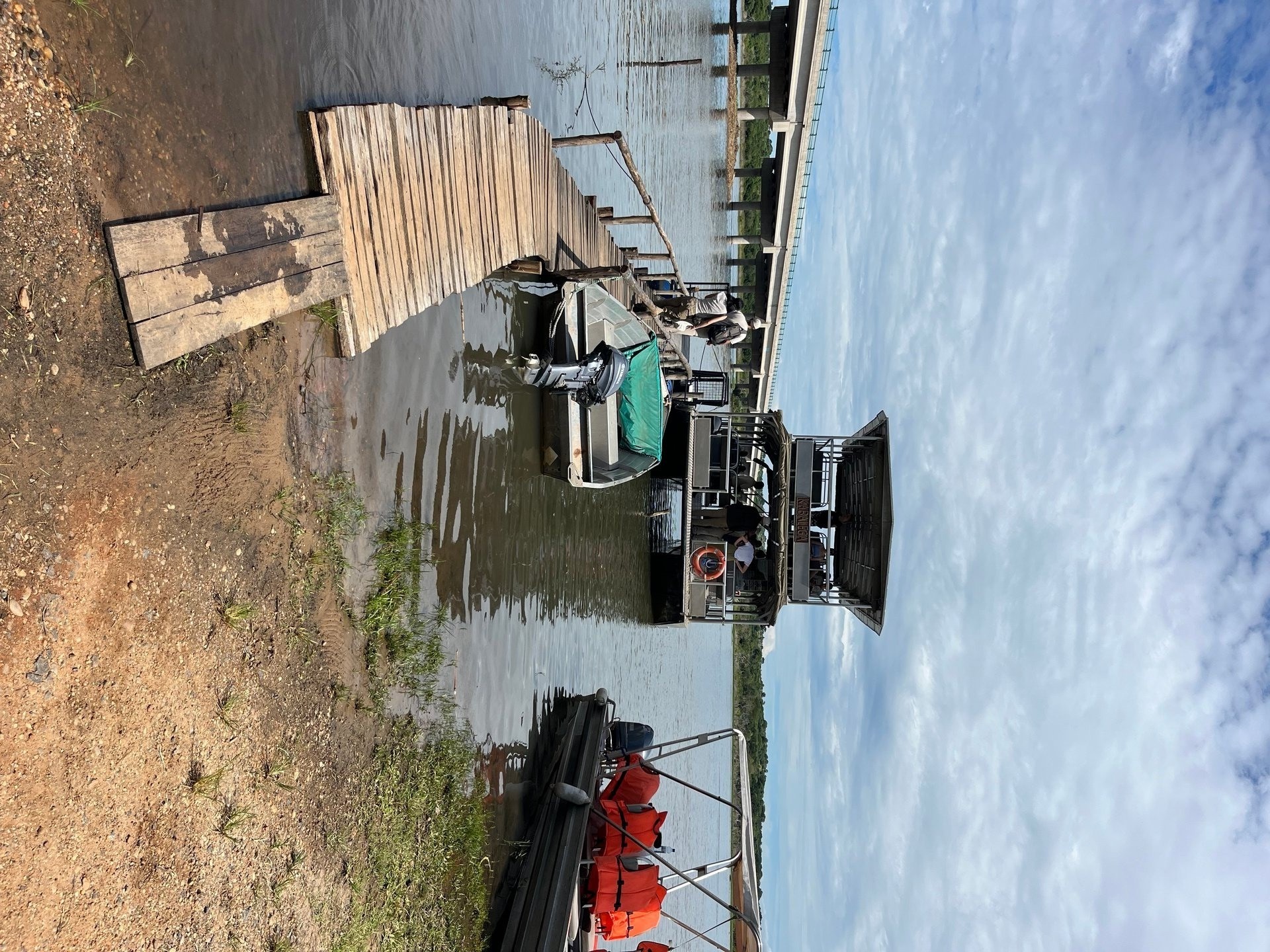
The boat held about fourteen people. It had life jackets for all of them and a roof for shade, which on a bright October afternoon on the Victoria Nile mattered considerably. The boarding point felt a little provisional — a short wooden jetty, the river moving quietly past — and the vessel itself was not designed for comfort. It rocked. But within the first ten minutes of moving upstream, the reason to endure any of that became clear: a hippopotamus surfaced thirty metres to port, regarded the boat with mild contempt, and submerged again. A Goliath heron stood motionless at the bank. A Nile crocodile the length of a small car occupied a gravel spit, completely indifferent to our passage.
This was the Victoria Nile in Murchison Falls National Park, in October 2024 — the third day of a twelve-day stay in Uganda. The river at this point in its journey is wild in the way that very few rivers still are. It has come from Lake Victoria, dropped through the famous falls upstream, and is making its way northwest toward Lake Albert, alive with species that have lived along its banks for millions of years. What I could not fully appreciate from that boat was how dramatically different a section of the same river, 200 kilometres to the south near Jinja, had been altered by a single piece of infrastructure: the Bujagali Dam.
The Victoria Nile: From Lake Victoria to Lake Albert
The Victoria Nile is the name given to the Nile from its exit at the Owen Falls dam site at Jinja — where the river leaves Lake Victoria — until it enters Lake Albert. Over this stretch of approximately 200 kilometres, the river drops through waterfalls, gorges and rapids before broadening into the flat delta that feeds Lake Albert. Murchison Falls is the most dramatic point in this journey: the entire river is forced through a gap barely seven metres wide before plunging 43 metres, creating one of the most powerful waterfalls on the continent.
The Upper Victoria Nile — the section closest to Jinja and the lake — was historically characterised by a different kind of energy: a series of rapids and falls including the Bujagali Falls, about eight kilometres downstream from Jinja town. These rapids formed a distinct aquatic habitat, fast-moving and well-oxygenated, supporting fish assemblages different from those found in either the lake or the calmer middle stretches of the river. They also attracted tourists. By the early 2000s, Bujagali had become one of East Africa's premier white-water rafting destinations, with Grade 4 and Grade 5 rapids drawing rafting operators and adventure travellers from across the region and internationally.
Then the dam arrived.
What the Bujagali Dam Changed — and What It Was Designed to Do
The Bujagali Hydroelectric Power Station was completed and began generating electricity in 2012. With an installed capacity of 250 megawatts, it was constructed by the Bujagali Energy Limited consortium and represented the largest private sector infrastructure investment in Uganda's history at the time. The dam's primary purpose was unambiguous: Uganda faced severe power deficits, with load shedding affecting homes and businesses for over a decade. Bujagali was intended to address this deficit by harnessing the considerable flow of the Victoria Nile.
The dam achieved its energy objective. It contributes substantially to Uganda's national grid and reduced load shedding in the years following its commissioning. The trade-off was the reservoir that formed behind it, which submerged the Bujagali Falls and the rapids immediately upstream. The ecological and tourism implications of that submergence have unfolded over the decade since, documented in part through Uganda's National Status of the Environment Report 2024 (NSOER 2024).
Under Uganda's National Environment (Audit) Regulations (S.I. No. 47 of 2020), reservoirs and impoundments with a capacity of 1,000,000 cubic metres or more are required to undergo environmental compliance audits every three years. The Bujagali reservoir falls well within this threshold. The same regulations require that dams and water diversions extracting more than 400 cubic metres per day undergo compliance auditing — a provision that applies to hydroelectric operations and large-scale irrigation schemes drawing on the same river system. These legal requirements reflect an understanding that large water infrastructure does not cease to have ecological obligations once it begins generating power.
How the Dam Altered Fish Populations in the Upper Victoria Nile
The ecological changes documented in the Upper Victoria Nile following the dam's construction are specific and measurable. Uganda's NSOER 2024 records reductions in Nile perch populations in the affected river section, alongside changes in the composition of smaller fish species that form the base of the food chain. The changes are not a simple story of loss — they are a reorganisation of species assemblages in response to altered habitat conditions.
Nile perch (Lates niloticus) in the Upper Victoria Nile relied partly on the riverine sections of fast water as part of their movement patterns. The reservoir created by the dam replaced a complex rapids environment with a slower, more lake-like body of water. This transition favoured some species and disadvantaged others. According to NSOER 2024, Nile perch numbers in the Upper Victoria Nile were reduced after dam construction — a finding consistent with what is understood about Nile perch's habitat requirements and the distinct ecology of moving versus still water.
Haplochromine cichlids, the diverse group of small fish that occupy almost every available ecological niche in East African water bodies, were also affected. The cichlid assemblage of the Upper Victoria Nile in the rapids sections was distinct from the lake cichlid fauna, adapted to fast-flowing, well-oxygenated water. With those conditions submerged, the habitat that supported that particular assemblage ceased to exist. This kind of localised cichlid loss is documented but difficult to quantify precisely, as comprehensive baseline surveys of the pre-dam rapids fauna were not completed before construction.
One species that has shown unexpected resilience is Labeobarbus altianalis, a large riverine cyprinid fish sometimes called the Ripon barbel. NSOER 2024 records signs of recovery in Labeobarbus populations in river sections upstream of the Bujagali Dam — above the impounded zone, where riverine conditions persist. This is significant: it suggests that where suitable habitat remains, certain native species can re-establish populations if fishing pressure does not overwhelm the recovery signal. NAFIRRI, based at Jinja at the river's exit from Lake Victoria, monitors these population trends across the Upper Victoria Nile system and informs fisheries management decisions under the Lake Victoria Fisheries Organisation framework.
Rastrineobola argentea — mukene, the small pelagic fish that supports both subsistence livelihoods and the aquafeed industry around Lake Victoria — has become more central to the ecological structure of the Upper Victoria Nile following Nile perch reduction. As Nile perch lost access to some of their preferred river habitat, their feeding patterns in the broader lake system shifted, with mukene becoming a proportionally more significant prey item. This dynamic illustrates how dam-driven changes at one point in the river system can propagate through food webs across a much wider area.
Bujagali Today: What Remains for Visitors
The loss of the Bujagali Falls did not end adventure tourism at Jinja. It reorganised it. The Grade 5 rapids downstream of the dam structure remained intact, and the operators who had built their businesses around them adapted. White-water rafting continues on the Victoria Nile below Bujagali, and Jinja retains its standing as one of the best rafting destinations on the continent — not despite the dam but around it.
Several operators run trips from the Bujagali area. Nalubale Rafting offers half-day tours from 125 USD per person, full-day trips at 140 USD, family-adapted options, and two-day itineraries reaching 195 USD per person. White Nile Rafting charges 125 USD for a half day and 140 USD for a full day. Adrift — The Adventure Centre, which also maintains an office in Kampala-Kololo, operates at the same price points: 125 USD half day, 140 USD full day. These are not budget prices, but the calibre of the rapids — and the scenery along the river — is commensurately serious.
Beyond rafting, the Bujagali area has developed a wider activity ecosystem. Wild Frontiers Nile River Safaris runs guided boat trips on the river, combining wildlife observation with the landscape experience in a format closer to the Murchison-style boat safari than to white-water adventure. Feather and Fin offers specialist fishing and bird-watching tours targeting the Nile's resident species from a slower, more deliberate angle. Nile Horseback Safaris operates rides along the western bank at the level of Lake Bujagali — a version of the riverine landscape that is unavailable from any other perspective. All Terrain Adventures provides quad bike excursions in close collaboration with the rafting operators, extending the activity day before or after time on the water.
Lodges at Bujagali
Accommodation at Bujagali ranges from camping-oriented river camps to a small number of higher-end lodge options. The Nile Porch Lodge occupies a forested cliff above Lake Bujagali on the eastern bank, with eight safari tents and two family cottages — a compact, well-positioned property for those wanting comfort close to the activity hub without being inside it. Nile River Camp and Explorers River Camp are the principal accommodation options operated by or in partnership with the rafting operators, providing access to the activity infrastructure with simpler facilities.
For visitors who want to combine the Bujagali river experience with a Lake Victoria perspective, the Jinja Sailing Club is located in Jinja town on the lake shore rather than the Nile riverbank. It offers a restaurant, resort facilities and what reviewers consistently describe as a well-equipped cocktail selection — a useful anchor point for itinerary planning in either direction.
Between the River and the Lake: Jinja and What Connects Them
Jinja sits at the point where Lake Victoria becomes a river. The Owen Falls Dam, built in 1954, modified the original flow dynamics at this point decades before Bujagali was conceived — the dam raised the lake's water level and regulated the river's exit volume in ways that shaped the ecology of the Upper Victoria Nile for generations. Bujagali was the second major structural intervention in a stretch of river already profoundly altered by the first.
What this means practically for visitors is that the Victoria Nile at Jinja is not a pristine river in any ecological sense. It is a managed water body within a heavily modified system, operating under two dams, subject to the outflow regimes of the second-largest freshwater lake on earth, and embedded in a region of intense agricultural and urban activity. The fish that remain in it — including the recovering Labeobarbus populations above Bujagali — do so within that constrained reality, not in spite of it.
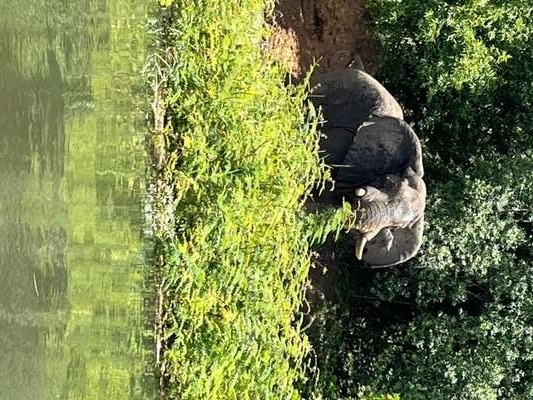
Understanding this does not diminish the experience of being on the river. During our boat safari in the wilder stretches near Murchison Falls, several days' drive north of Jinja, the difference between a managed and an unmanaged riverine landscape was palpable. The Murchison stretch carries something that the Jinja stretch has lost: a sense of ecological continuity, of processes running at their own pace without structural interruption. The elephant we watched drinking from the bank — calm, unhurried, completely indifferent to the boat — was operating within a system still largely shaped by natural forces. That contrast is worth knowing about when planning where on the Victoria Nile to spend time.
One stop between Jinja and Bujagali worth noting is Kilombera Weaving — a textile cooperative on the eastern Nile bank producing handwoven fabric in both traditional and contemporary patterns. It is a small operation, not prominently signposted, but represents the kind of craft production that connects the river landscape to local livelihoods in a way that no amount of rafting or boat safari can.
[QUOTE: local guide at Bujagali on how the river changed after the dam]
The NSOER 2024 data on Upper Victoria Nile fish populations reflects monitoring conducted by NAFIRRI over the years since the dam's commissioning. NAFIRRI's Jinja research station has produced stock assessments for the major commercial and ecologically significant species in both the lake and the river, providing the scientific grounding for fisheries management decisions taken by the Lake Victoria Fisheries Organisation (LVFO) — the intergovernmental body coordinating fisheries governance across Uganda, Kenya and Tanzania. The dam's environmental compliance auditing, required every three years under S.I. No. 47 of 2020, feeds into a broader monitoring architecture that includes NAFIRRI's independent population assessments. Whether those mechanisms are sufficient to detect and respond to further ecological change is a question the data will eventually answer.
Explore Further
Frequently Asked Questions
What is the Bujagali Dam and where is it located?
The Bujagali Dam is a 250-megawatt hydroelectric power station on the Victoria Nile approximately 8 kilometres downstream from Jinja in eastern Uganda. It began generating electricity in 2012 and submerged the Bujagali Falls that had previously defined the upper section of the white-water rafting route. The dam is one of Uganda's largest power sources and was developed by the Bujagali Energy Limited consortium as the country's biggest private sector infrastructure investment at the time.
How did the Bujagali Dam affect fish in the Victoria Nile?
According to Uganda's NSOER 2024, the dam reduced Nile perch populations in the Upper Victoria Nile and altered the composition of fish species in the impounded zone. Haplochromine cichlids adapted to fast-flowing rapids lost their habitat when the reservoir formed. Labeobarbus altianalis has shown signs of recovery upstream of the dam where riverine conditions remain. Rastrineobola argentea (mukene) became proportionally more significant as Nile perch feeding patterns shifted in the broader system. NAFIRRI in Jinja monitors these population changes and reports findings to the Lake Victoria Fisheries Organisation.
Is white-water rafting still possible at Bujagali after the dam?
Yes. Grade 5 rapids downstream of the dam structure remain intact and active operators include Nalubale Rafting (125–195 USD per person), White Nile Rafting (125–140 USD), and Adrift — The Adventure Centre (125–140 USD). Half-day and full-day options are available from all three. The reservoir submerged the upper section of the original route, but the most technically demanding rapids are downstream of the dam and were not affected by the impoundment.
What accommodation is available near Bujagali on the Victoria Nile?
The Nile Porch Lodge is the main higher-end option — eight safari tents and two family cottages on a forested cliff above Lake Bujagali. Explorers River Camp and Nile River Camp are activity-affiliated mid-range camps. The Jinja Sailing Club, located on Lake Victoria in Jinja town, offers resort facilities and a restaurant. Most operators also have camping areas attached to their river camps.
What activities are available at Bujagali beyond rafting?
Guided river boat safaris (Wild Frontiers Nile River Safaris), fishing and birding tours (Feather and Fin), horseback riding along the river (Nile Horseback Safaris), quad biking (All Terrain Adventures), and kayaking (Kayak the Nile, based at Nile River Camp) are all available in the Bujagali area. Kilombera Weaving, a handwoven textile cooperative between Jinja and Bujagali on the eastern bank, is worth a stop for locally produced fabric.