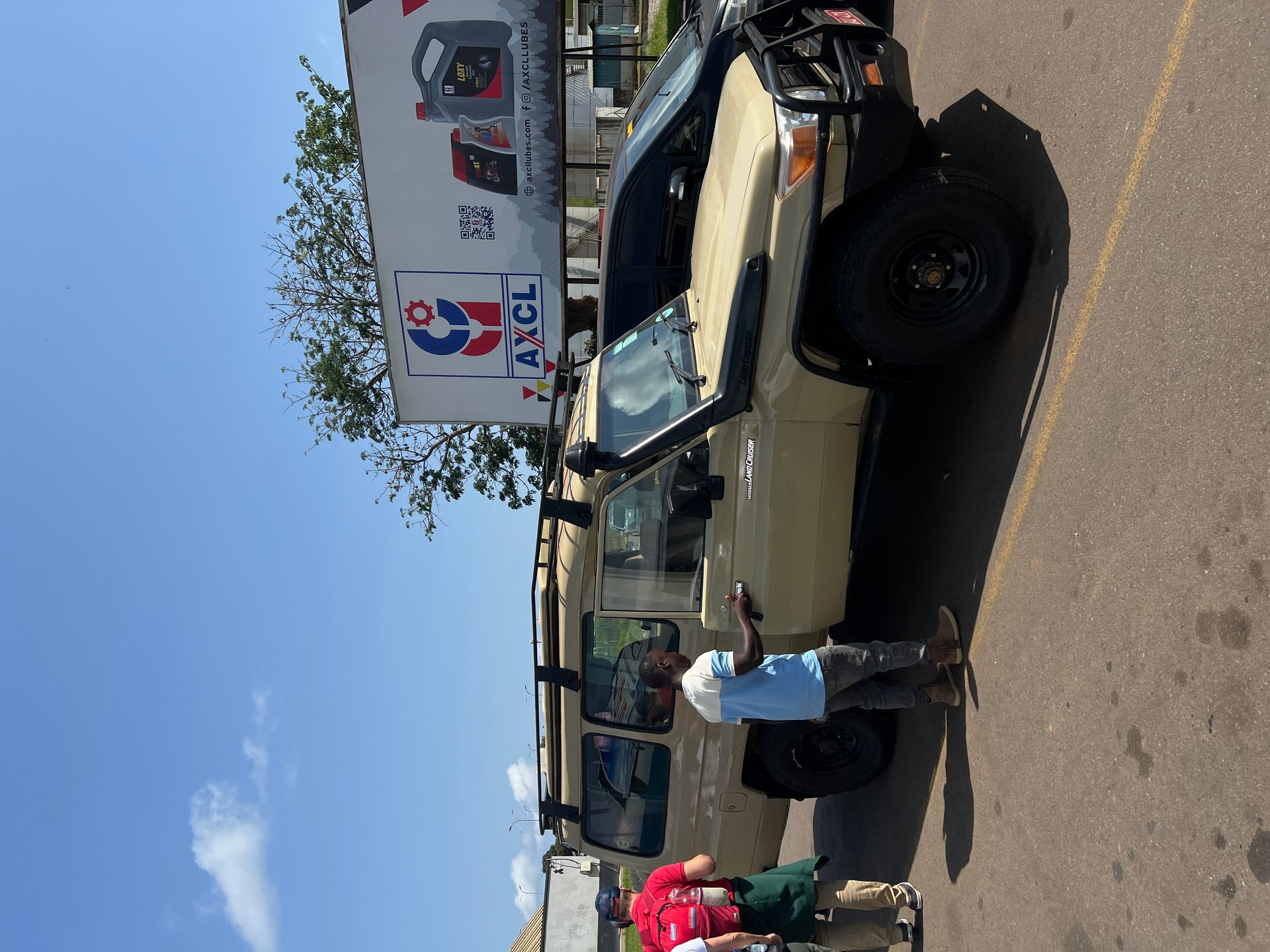
The safari jeep at Entebbe Airport, January 2026 — your base for exploring Lake Victoria's shores. GPS: 0.0442, 32.4443 — Photo: Mark Suer
Where to go, how long it takes, and what to expect — from fishing villages and swamp birding to island sanctuaries and the source of the Nile
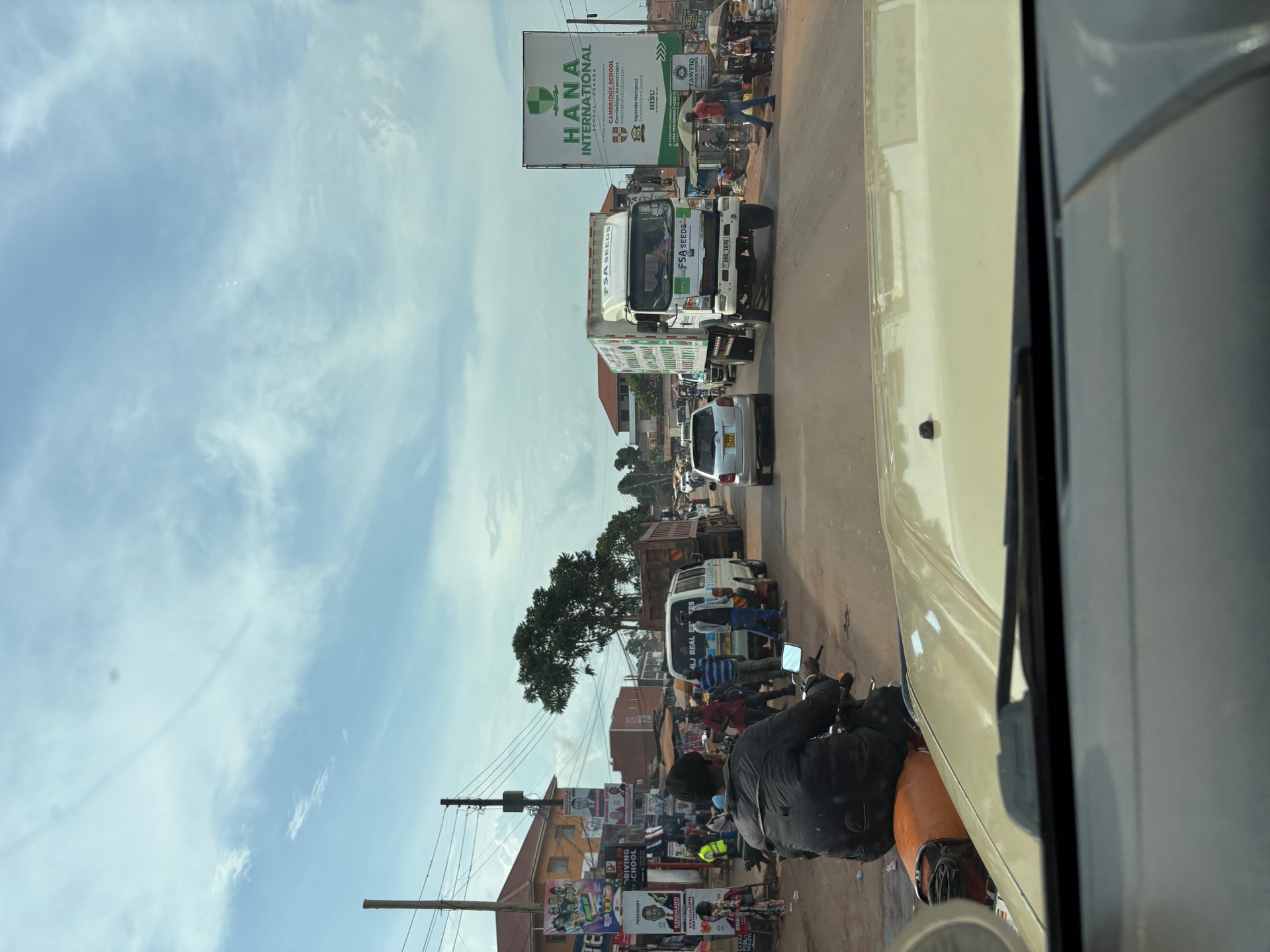
The drive from Entebbe to Kampala — a distance of 42 kilometres documented in the Kampala City Statistical Abstract 2019 — is rarely quiet. From the moment the car leaves the airport peninsula, where Lake Victoria's flat surface stretches south to the horizon, the road moves through a continuous ribbon of activity: roadside commerce, boda boda riders weaving between vehicles, minibus stops that double as impromptu markets, the smell of grilled food drifting through an open window. By the time Kampala's hillside skyline appears, a first-time visitor has already absorbed a year's worth of impressions before any formal sightseeing has begun.
The Kampala arrival experience — which I have made multiple times, on visits in October 2024, January 2026 and May 2026 — sets the context for understanding Lake Victoria's relationship with Uganda's capital. The lake is never more than a few kilometres from the city's southern edge, yet most visitors pass through Kampala without ever reaching the water. This guide is for those who want to change that: to spend time on or beside Lake Victoria rather than simply near it, using the city as a base for exploring the lake's islands, fishing communities, wetlands and waterways within a single day or overnight from Entebbe or Kampala.
The opportunities range from a forty-five-minute boat crossing to Ngamba Island's chimpanzee sanctuary to a half-day at Mabamba Swamp for one of Africa's most sought-after bird sightings, to a two- to three-hour drive to Jinja and the point where the Victoria Nile departs the lake. Each requires some planning but none requires more than a day's commitment from a Kampala or Entebbe base.
Ngamba Island is the most reliably bookable lake destination from Entebbe. The island sits approximately 23 kilometres south of Entebbe's waterfront — a direct boat crossing of around 45 minutes — and hosts the Ngamba Island Chimpanzee Sanctuary, which has operated since 1998 as a permanent home for rescued chimpanzees from Uganda and neighbouring countries.
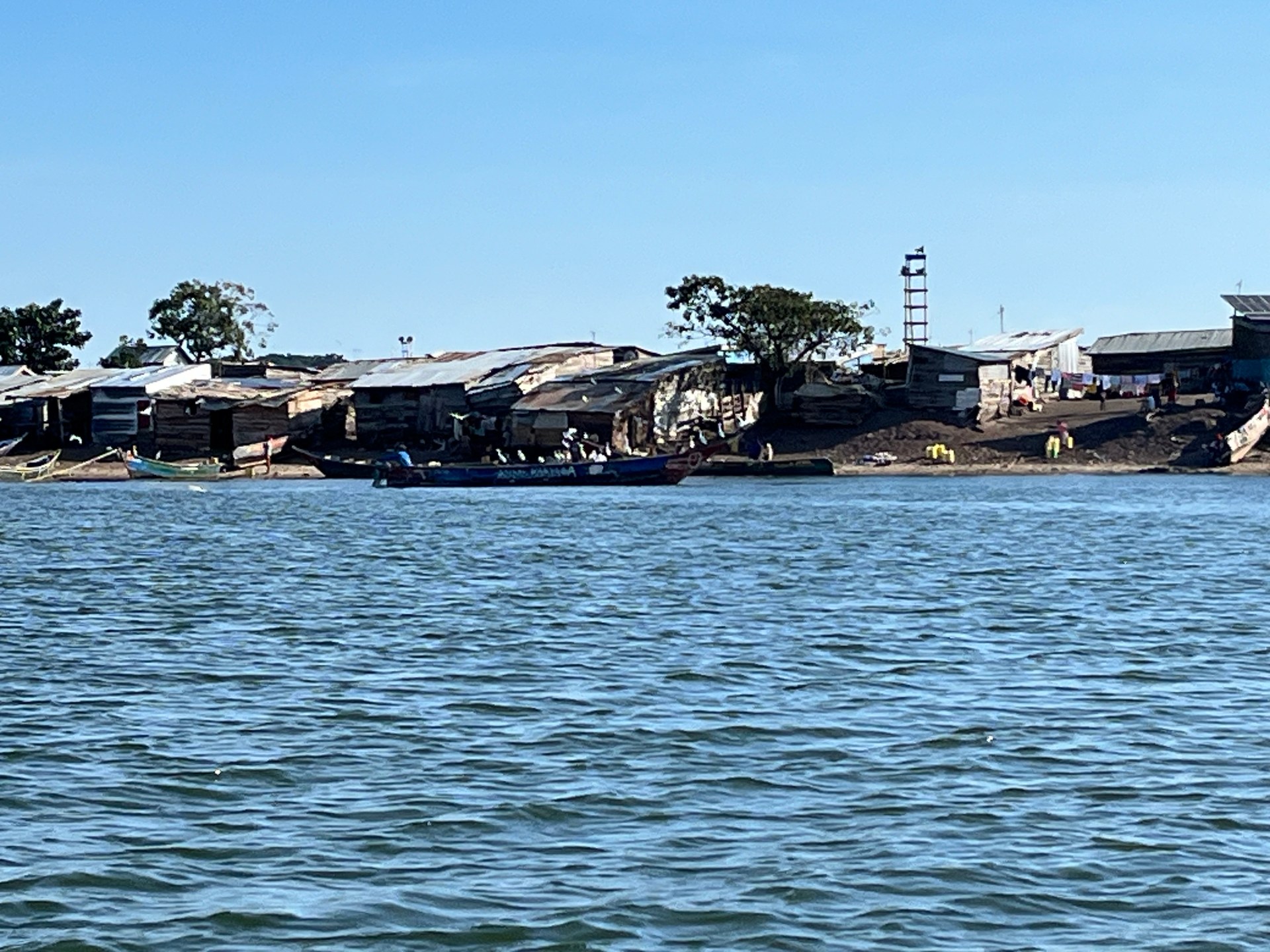
On the October 2024 crossing — photographed from GPS coordinates 0.0442, 32.4443 at the Entebbe departure point — the boat passed a smaller, unnamed island midway across. From the water, the whole of it was visible in a single glance: wooden houses, corrugated iron roofs, boats drawn up on a narrow bank, people moving along the shore with the unhurried purposefulness of a community that has organised its entire life around the rhythms of the lake. No power lines, no visible road. We observed from the passing boat as the island's activity continued around us, entirely self-contained. That kind of proximity to off-grid island life — fishing communities that exist completely outside the urban infrastructure of Kampala — is itself one of the lake's most striking aspects, visible even on a transit journey to a better-known destination.
Ngamba is reached through tour operators in Entebbe or booked directly through the sanctuary. Day trips include the boat crossing, a guided visit during the chimpanzees' afternoon feeding session, and return. Overnight stays are available in the sanctuary's own accommodation for those wanting an early morning experience before day visitors arrive. The island is roughly 100 hectares, of which approximately 95 are forested habitat available to the resident chimpanzees.
Mabamba Swamp sits on Lake Victoria's northwestern shore, west of Entebbe, and is the most reliable site in Uganda for observing the shoebill stork — one of Africa's most distinctive and sought-after birds. The shoebill is enormous (standing up to 1.5 metres, with a wingspan exceeding 2.5 metres), prehistoric in appearance, and almost entirely still for extended periods as it hunts lungfish in the shallow papyrus-lined water. Finding and watching one requires a small dugout canoe, a local guide who knows the swamp channels, patience, and ideally an early morning start before wind picks up on the lake surface.
Getting to Mabamba from Entebbe takes approximately an hour by road to a lakeside embarkation point, followed by a short paddle into the swamp by canoe. The experience is categorically different from any other wildlife encounter near Kampala: the sound of frogs and insects replacing traffic, the papyrus walls of the channel narrowing overhead, the open lake visible through gaps in the vegetation as the canoe moves slowly through still water. This is the Lake Victoria that most visitors who pass through Entebbe never see.
Mabamba is also an important site for other waterbird species: African jacana, black-and-white casqued hornbill, pygmy kingfisher and various herons are regular sightings. The swamp forms part of the broader wetland system that lines much of Lake Victoria's northern shore — a system that the previous articles on this site have covered in the context of conservation and water hyacinth management. From a visitor perspective, Mabamba is the most accessible and rewarding entry point into that world.
Not every Lake Victoria day trip needs to involve a boat crossing or a swamp paddle. Kasenyi village, approximately eight kilometres east of Entebbe, and Gaba landing site in Kampala's Makindye Division offer direct land access to the working life of the lake's fishing communities — an experience that is both free and entirely authentic.
Kasenyi is a fishing village on a peninsula below the Kampala road, with boat connections toward the Ssese Islands and a landing site where fish arrives throughout the morning. Visiting before 9am captures the peak activity: boats returning with overnight catches, the fish laid out for sale, buyers from Kampala's markets making their selections. By mid-morning the momentum slows and the boats are being maintained or rigged for the next departure. The village has no entry requirement, no organised tourism infrastructure, and no queue. It simply operates according to its own rhythms, and visitors who arrive quietly and respectfully are accommodated without fuss.
Gaba landing site, accessible from central Kampala in roughly thirty minutes by car (more in heavy traffic), offers a similar experience on the edge of the city itself. It sits within Kampala's over-19-kilometre Lake Victoria shoreline (KCCA Strategic Plan 2025) — a figure that surprises most visitors who associate Kampala with hills and traffic rather than lake frontage. Gaba is a functioning commercial landing site, not a tourism destination, and that is precisely what makes it worth visiting: it shows the lake as an economic engine rather than a scenic backdrop.
The Kampala Capital City Authority has been investing in landing site infrastructure through the Kampala Fisheries Infrastructure Improvement Project, aimed at improving handling facilities, waste management and basic amenities at sites like Gaba. The KCCA Strategic Plan 2025 also references plans for 20 jetties for water transport and tourism around Lake Victoria — an ambition that, if realised, would significantly improve public access to the lake from Kampala's shoreline for both commercial and recreational users.
The broader context is one of managed transition in how Ugandans relate to Lake Victoria's fishery. The scale of dependence is significant: Lake Victoria accounts for approximately 40% of Uganda's total fish catch, with around 136,000 artisan fishermen operating on the lake and a further 700,000 people benefiting from related activities in processing, trading and transport. In Buikwe District alone — which borders the lake east of Kampala — around 70,000 people depend directly on fishing as their primary livelihood. Wild-catch artisanal fishing remains the dominant model at landing sites like Gaba and Kasenyi, but aquaculture — fish farming in ponds and lake pens — is expanding in the districts adjacent to Kampala. The KCCA Agricultural Resource Centre supports farmers including aquaculture operators with training and advice, and Uganda Wildlife Regulations 2022 provide the legal framework governing how fish stocks are managed within the lake's Ugandan sector. The shift toward aquaculture reflects both commercial opportunity and the reality that the wild fishery faces long-term pressure from population growth, overfishing and the ecological legacy of past disruption.
The Ssese Islands — a group of 84 islands in Lake Victoria's Ugandan sector, of which Kalangala is the largest and most developed — are at the outer edge of what is practical as a day trip. The car ferry from Bukakata, on a spur road off the Masaka Highway, takes two to three hours each way; the fast passenger boat from Entebbe is faster but still involves a full crossing. In practical terms, the Ssese Islands are a two-day minimum destination, with at least one night at Kalangala to justify the journey.
What makes the Ssese Islands worth the longer commitment is precisely their distance from the mainland. The crossing itself is part of the experience: open water in every direction, the islands appearing as dark green shapes on the horizon, the mainland disappearing behind. Kalangala has several accommodation options at different price points, including the Victoria Forest Resort with its lakeside beach and pool. The island's forest interior, accessible on foot or by bicycle, is a genuine tropical forest environment — distinct from the managed parkland of Entebbe's botanical garden and far wilder in character.
For those combining a Lake Victoria trip with travel to southwestern Uganda — Bwindi, Lake Bunyonyi or the Rwenzori — the Bukakata ferry can be used as a staging point on the Masaka Highway, adding the lake crossing to an itinerary rather than making it a separate excursion.
Jinja lies 81 kilometres east of Kampala (Kampala City Statistical Abstract, 2019) — a drive of approximately ninety minutes to two hours depending on traffic. It is the point where the Victoria Nile departs Lake Victoria, and the combination of that geographical significance with a growing adventure-tourism scene makes it the most diverse day-trip destination reachable from Kampala.
The Source of the Nile, marked at Jinja with a simple monument and boat trips across the bay to the outlet itself, is the formal historical attraction: the site identified by John Hanning Speke in 1862 as the origin of the world's longest river. The Owen Falls Dam (now Nalubaale Dam), which submerged the original Ripon Falls outlet when it was constructed in 1954, changed the physical appearance of the site but not its geographical significance. The Victoria Nile still leaves the lake here, still flows north through Lake Kyoga, still descends through Murchison Falls, and still eventually reaches the Mediterranean more than 6,600 kilometres away.
Below the Bujagali dam, completed in 2012 and responsible for submerging the famous Bujagali Falls, whitewater sections of the Victoria Nile remain active for kayaking and rafting. Jinja has built a substantial adventure tourism infrastructure around these, with several operators offering half-day and full-day river experiences. The combination of the historical site, river activities, and Jinja's own growing restaurant and accommodation scene makes this a full day rather than a rushed visit.
The travel from Kampala to Jinja passes through countryside that shows the lake's agricultural hinterland — sugar plantations, market towns, the Lake Victoria crescent that is one of Uganda's most productive agricultural zones. This landscape, visible from the car window, puts the lake's role in Uganda's food security into a geographic perspective that maps cannot fully convey.
Uganda's two dry seasons — December to February and June to August — provide the most comfortable conditions for all of the trips described above. Boat crossings are calmer, roads drier, and the risk of disruption from sudden heavy rain lower. My October visits fell within the shorter rainy season and were entirely workable: the boat crossing to Ngamba Island in October 2024 was made in clear morning conditions, the afternoon weather aside, and the roads were in reasonable condition throughout.
The most important practical rule for lake-based day trips is to book boats and guides in advance, particularly for Ngamba Island and Mabamba Swamp. Both destinations have limited capacity and limited staff, and arriving without a booking can mean a wasted journey. Kasenyi and Gaba, by contrast, require no booking — they are working landing sites that simply operate whether or not visitors appear.
Transport logistics follow from the destination. A pre-arranged private vehicle with a driver is the most practical option for any trip that combines multiple stops or requires early departure — the Mabamba shoebill, for instance, is best seen before 8am, which means leaving Entebbe by 6:30, which means a driver who is ready well before the taxi-app market is awake. For Jinja, the shared taxi system from Kampala's taxi parks works efficiently, with frequent departures throughout the morning.
The KCCA is working toward improving formal transport options within and around Kampala. The planned Bus Rapid Transit corridor of 14.4 kilometres (KCCA Strategic Plan 2025) and two new bus terminals along the main arterial roads will, when operational, change how city-based travellers access the lake's southern districts. For now, the boda boda and the private car remain the dominant tools — and the view from either, passing through Kampala's roadside commerce on the way to the water, is its own kind of introduction to the country.
The most accessible are: Gaba landing site in Kampala itself (no transport beyond a city drive); Kasenyi fishing village near Entebbe; Ngamba Island Chimpanzee Sanctuary by boat from Entebbe (45 minutes); and Mabamba Swamp for shoebill stork observation (about 1 hour from Entebbe by road and canoe). Jinja and the Source of the Nile, 81 km east of Kampala, is a longer day trip but fully manageable. The Ssese Islands are better suited to an overnight stay than a day trip.
Entebbe itself sits on the lake — the airport peninsula is surrounded on three sides by water, and the town's botanical garden has direct lake access. Gaba landing site in Kampala is reachable by car in about 30 minutes from the city centre. For Ngamba Island and Mabamba Swamp, you need a boat arranged through a local operator or hotel. Kasenyi village, east of Entebbe on the lakeshore, is reachable by boda boda or car and requires no boat. A private transfer is recommended for early morning departures targeting Mabamba's shoebill.
Mabamba Swamp is a papyrus wetland on Lake Victoria's northwestern shore, west of Entebbe, and the most reliable site in Uganda for observing the shoebill stork. Getting there involves about an hour's drive from Entebbe to a boat launch point, followed by a canoe trip through the papyrus channels with a local guide. Visits are best made early morning when shoebills are most active and wind on the lake is lowest. Bookings can be arranged through Entebbe guesthouses or tour operators. There is a community-managed entrance fee at the site.
The dry seasons — December to February and June to August — offer the most reliable conditions for both boat travel and road access to lake destinations. October and November (short rains) are workable but afternoon storms can develop quickly over the lake, making morning boat departures strongly preferable. May and April (long rains) carry the highest disruption risk. I visited in October 2024 and January 2026 and found both periods fully usable, with the January dry season offering clearer skies and calmer water conditions.
Yes, at landing sites like Kasenyi (near Entebbe) and Gaba (in Kampala's Makindye Division), visitors can walk in without booking or fee and observe the morning fish landing and market activity. The busiest time is roughly 6–9am when boats return from overnight fishing. No formal tourism infrastructure exists at these sites — they are working commercial landing stages — so the expectation is that visitors arrive quietly, purchase something if they wish (fresh fish or food from stalls), and observe without disrupting operations. The KCCA's Fisheries Infrastructure Improvement Project is upgrading facilities at these sites over time.