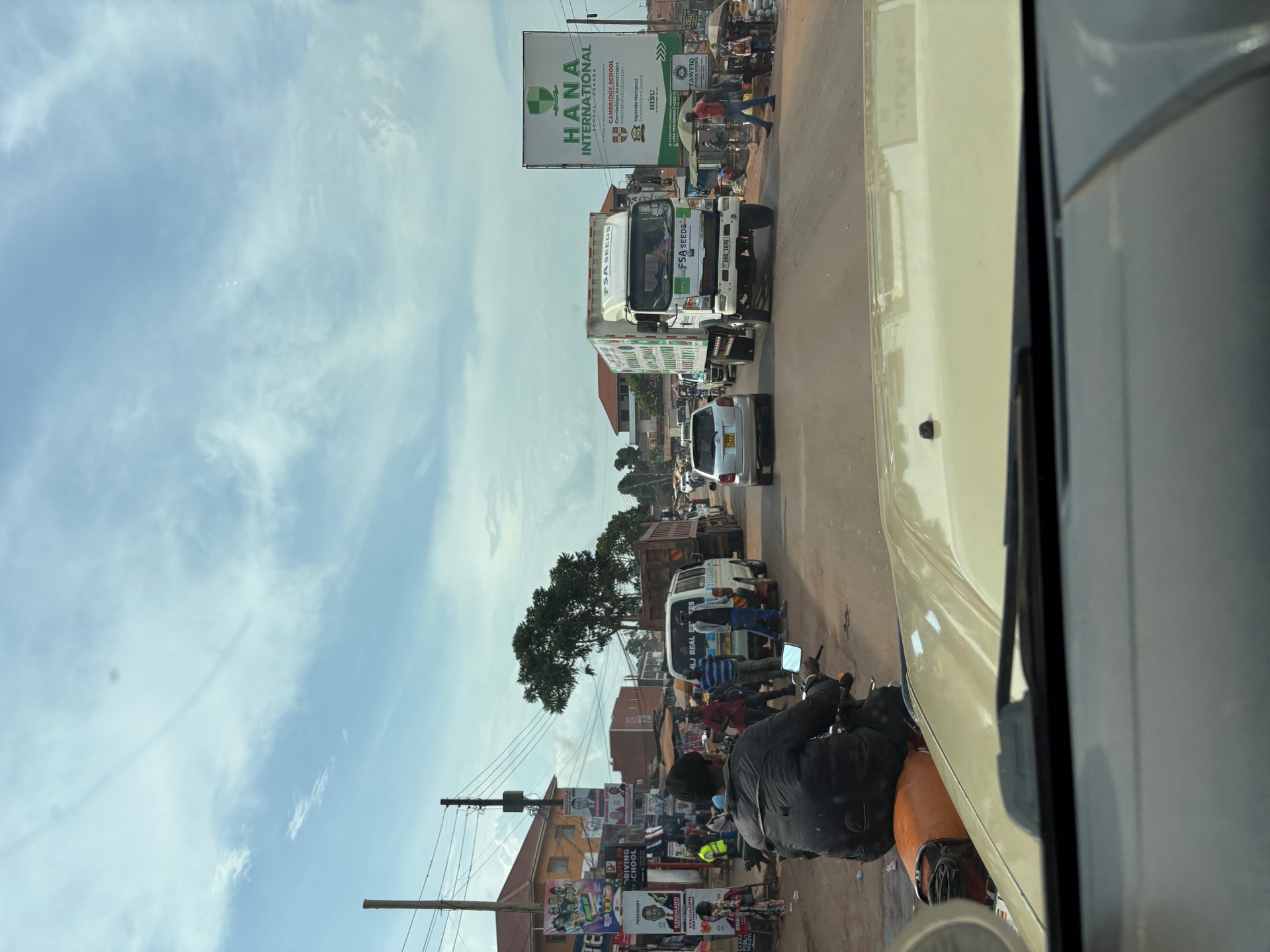
After being collected from the airport at Entebbe, the road north takes you directly through Kampala. There is no bypass that avoids the city in any meaningful sense — the capital sits between the lake and most of Uganda's interior, and the main arteries pass through it. The first impression is density: vehicles of every description moving in every direction at once, boda bodas threading between the larger cars with a confidence that suggests they have made this journey a thousand times, roadside stalls pressed right up to the kerb with goods stacked or hung or laid out on tarpaulins, and people walking among it all with complete equanimity. I passed through Kampala this way in October 2024 and again in January 2026, and each time the energy of the city hit immediately after the relative quiet of the airport road.
The photographs I took during those transits — GPS-tagged on both occasions — show the texture of this experience more honestly than any description: the red laterite dust on the lower sections of vehicles, the yellow-jacketed boda boda riders clustered at junctions, the handwritten signs on small shops advertising mobile money transfers, hardware, pharmacies and food. This is a working city, not a tourist city, and it moves to its own logic rather than any itinerary. For most visitors arriving for Lake Victoria or the national parks upcountry, Kampala is something to pass through. Understanding what you are passing through — and what is currently being done to it — makes the transit considerably less mysterious.
Kampala: Five Divisions, One Economic Gravity Centre
Kampala is not simply the capital city — it is the economic core of Uganda. The metropolitan area encompassing Kampala, Wakiso and Mukono concentrates over 32% of Uganda's manufacturing activity, and the city generates approximately 65% of the national GDP (Multi-Hazard Risk and Vulnerability Profile, 2018). This economic weight is a reason for the traffic, not simply a coincidence with it. When a country's productive and commercial activity is concentrated in one place, the roads into and through that place carry corresponding pressure.
The city is administered through five divisions: Central, Makindye, Lubaga, Kawempe and Nakawa. The Kampala Capital City Authority (KCCA) — established as a legal entity with both administrative and technical responsibilities — manages infrastructure, public health, markets, schools and environmental regulation across all five. The KCCA Statistical Unit produces and disseminates data that underpins planning decisions city-wide. For visitors trying to understand why the city feels the way it does, the five-division structure is useful context: each division has distinct character, density and infrastructure challenges, and the problems being addressed by the roads project are distributed unequally across them.
Kira Municipality borders Kampala to the east and forms part of the wider metropolitan area that the KCCA governance structure covers. The city has expanded into surrounding districts faster than administrative boundaries have shifted, creating a practical metropolitan area considerably larger than the formal city limits.
The Kampala City Roads Rehabilitation Project
The most significant piece of infrastructure investment currently reshaping Kampala's streets is the Kampala City Roads Rehabilitation Project — Project 1658 in Uganda's government budget framework. For the financial year 2024/25, the project carried approved total budget costs of approximately 469 billion Uganda Shillings, according to the Ministry of Public Service MPS 2024-25. This represents a substantial increase over previous years and reflects both the scale of road degradation that had accumulated and the availability of external financing to address it.
A significant portion of the 2024/25 funding comes from an off-budget contribution of approximately 143 billion Uganda Shillings from JICA — the Japan International Cooperation Agency — specifically allocated to machinery and equipment maintenance for the road works. Off-budget support means the funding flows outside the standard government appropriation process, generally with additional accountability requirements to the donor. JICA's involvement in Kampala's urban infrastructure has been a feature of development cooperation in Uganda for over a decade, and the roads programme represents one of the largest applications of that cooperation in the current cycle.
Budget allocations for the 2023/24 financial year illustrate how the project distributes across divisions. Makindye Division received the largest allocation at approximately 526 million Uganda Shillings for road rehabilitation. Central Division received approximately 367 million UGX, and Lubaga Division received approximately 271 million UGX. These figures from MPS 2024-25 should be verified against updated KCCA project data, as allocations shift between financial years as works are completed or prioritised differently.
For visitors, the practical implication of an active road rehabilitation programme is disrupted surface conditions on roads that would otherwise carry heavy traffic. Detours, reduced lanes, sections of freshly laid tarmac adjacent to sections of red earth, and increased heavy equipment presence on urban roads are all normal features of an active programme of this scale. The disruption is temporary in any given location but the programme is multi-year, so at any given moment parts of the city will be easier to navigate than others. Traffic that might take 45 minutes on a cleared road can take two hours when a major junction is under active work.
Boda Bodas: How the City Actually Moves
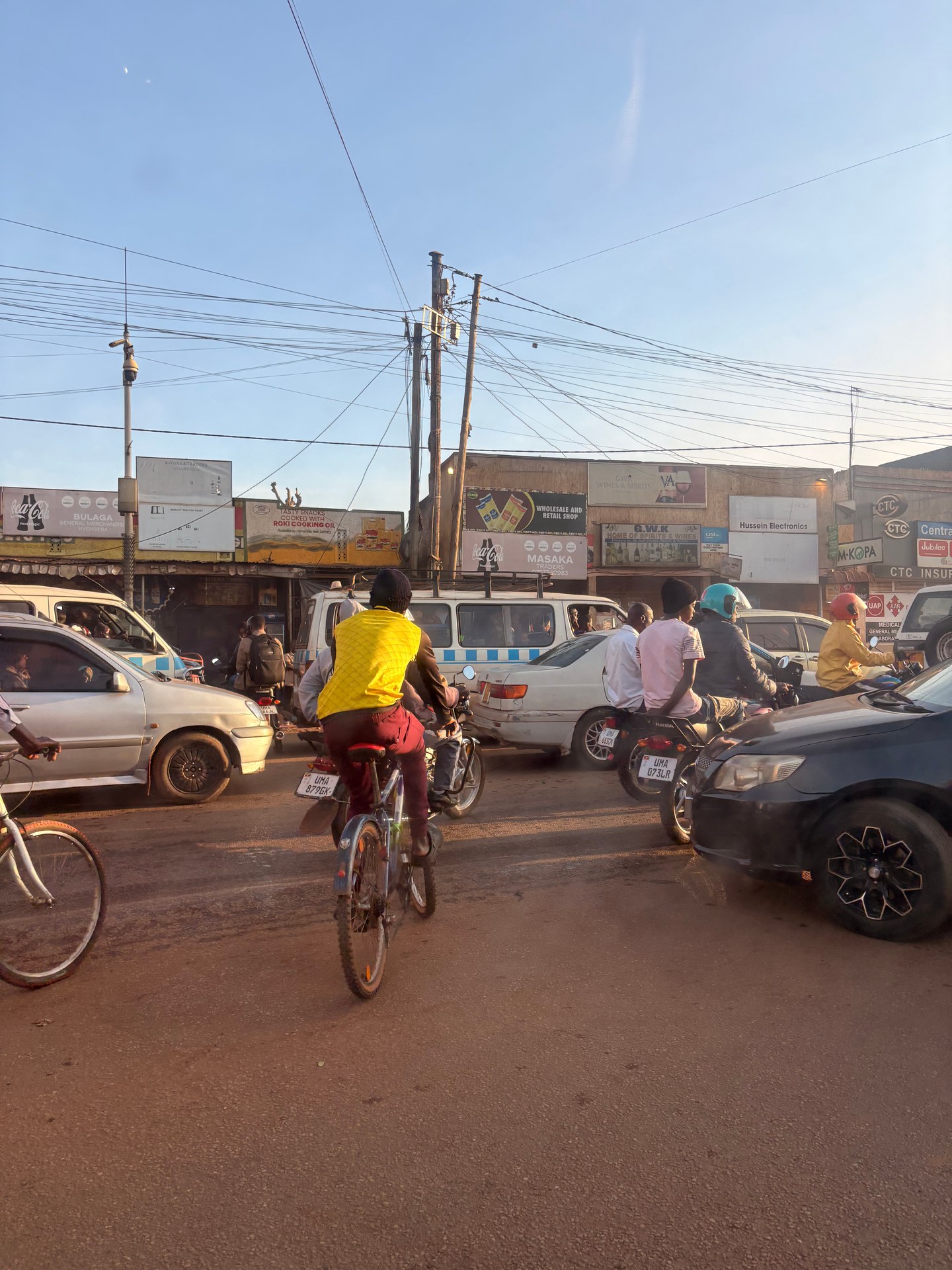
No account of Kampala traffic is complete without the boda boda — the motorcycle taxi that functions as the city's most responsive transport option and contributes substantially to both its mobility and its risk profile. In heavy traffic, boda bodas filter through gaps that nothing else can use. They are faster than any other option when the main roads are gridlocked, they are everywhere, and they cost a fraction of what a taxi or car hire charges for short journeys.
The trade-off is safety. Helmets are inconsistently worn. Passenger helmets are even less common. The driving style that makes boda bodas effective in traffic — close proximity to other vehicles, willingness to use road shoulders and pavements, rapid acceleration into gaps — is also the driving style that makes accidents when those gaps close unexpectedly. Kampala's multi-hazard risk profile identifies road traffic accidents as a significant urban hazard, and boda bodas are disproportionately represented in accident statistics.
For visitors, the practical guidance is straightforward: boda bodas are a genuine and useful transport option for short distances in the city, and many travellers use them without incident. Insisting on a helmet — which responsible operators carry — and agreeing a price before boarding are both standard precautions. For longer or unfamiliar routes, a vehicle is safer. For navigating a congested market junction when a meeting is in twenty minutes, a boda boda is probably the only option that arrives on time.
The scene I photographed in May 2026 at a busy Kampala junction showed what this looks like in practice: boda boda riders in their yellow jackets clustered at the lights, bicycles moving along the inside line, a mix of matatus, private cars and larger vehicles filling the main lanes, and pedestrians crossing on whatever gap opened up. It is not chaotic in the sense of being without order — everyone knows how this works — but it looks that way to a first-time visitor, and that impression is worth understanding rather than being alarmed by.
Kampala's Markets and the Road Between Entebbe and Murchison
The markets of Kampala are not primarily tourist destinations, but they are part of what makes the city legible as a living place rather than just a transit point. Owino Market, established in 1971 in the Central Division, is the largest second-hand clothing market in Uganda — a place where garments from European and North American charity donations are sorted, priced and sold by vendors who know their stock precisely. The scale is difficult to convey without having seen it: an entire economy of second-hand clothes, organised by type and quality and price, serving buyers who range from families replacing worn clothing to small-scale traders buying in bulk.
Nakawa Market in Nakawa Division has approximately 4,000 registered vendors operating in permanent structures. Wandegeya Market in Kawempe Division has 1,117 vendors and a reputation for food. Both are KCCA-administered registered markets, which means they operate under a management framework that includes fee collection, basic infrastructure and some level of sanitation oversight — a distinction from the entirely informal roadside trading that characterises much of the commercial activity visible from the main roads.
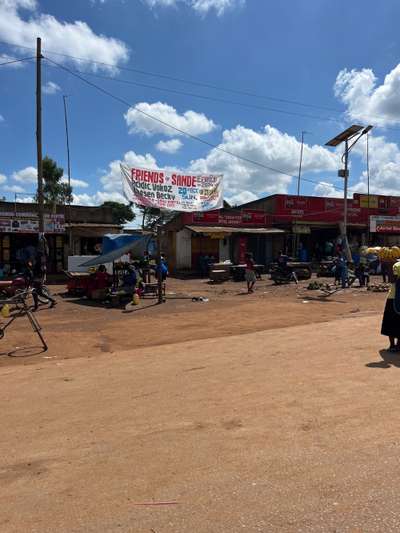
The Kampala Road that leads northeast from the city toward Jinja and eventually to Murchison Falls passes through a series of small towns that illustrate the transition from urban to rural Uganda. Lubwerro — sometimes spelled Luwerro — is one of them: a small town on the road with the standard composition of a Ugandan roadside settlement, small market stalls with red canvas awnings, simple permanent buildings housing hardware shops and pharmacies, and the particular quality of a place that exists primarily because the road passes through it. I drove through it in October 2024 on the way to Murchison Falls, and the friendliness of the place — the ease with which eye contact at a brief roadside stop was met with acknowledgement — was the kind of small thing that makes a country feel genuinely hospitable rather than just conventionally welcoming.
KCCA: What the City Authority Does and Why It Matters
The Kampala Capital City Authority (KCCA) is the administrative body responsible for running Kampala. It manages roads and drainage, public health, markets, parks, fire services, schools and environmental regulation across the five divisions. Its institutional structure is more complex than a typical municipal council: Kampala has a political dimension involving the directly elected Lord Mayor, but executive authority sits with an Executive Director appointed by the central government — an arrangement that has created tension between elected and appointed leadership since KCCA's establishment in 2011.
For the 2024/25 financial year, KCCA's education budget was approximately 65.6 billion Uganda Shillings, covering primary schools, secondary schools, tertiary institutions and teacher training (MPS 2024-25). This investment operates alongside the roads rehabilitation programme as part of a broader effort to bring Kampala's infrastructure and services closer to the level that a city generating 65% of national GDP might be expected to provide. The gap between what the city produces economically and what it has historically received in infrastructure investment is one of the central tensions in Ugandan urban development.
The Project 1686 Retooling of KCCA runs alongside the roads programme — it funds the modernisation of KCCA's own equipment and administrative facilities, including medical and administrative infrastructure. Environmental compliance at the city level involves the National Environment Management Authority (NEMA), which is headquartered in Kampala and sets the standards that KCCA must apply to its own operations, including road construction impacts on wetlands. The Lubigi wetland system near Kampala has been subject to restoration projects precisely because urban expansion — including road construction — had compromised it.
[QUOTE: Kampala resident on the difference roads construction has made to their neighbourhood]
Kampala's Cultural Layer: Buganda Kingdom and the Kasubi Tombs
Beneath the commercial and administrative surface of the city, Kampala sits within the territory of the Buganda Kingdom — one of the oldest and most historically significant kingdoms in the region. The relationship between the Kingdom and the national government is formally defined but culturally much deeper: Buganda institutions are woven into the identity of the city in ways that are visible in language, ceremony, the naming of places, and in the presence of the Kabaka's palace on one of Kampala's hills.
The Kasubi Tombs, in Lubaga Division, are the most internationally recognised expression of this cultural depth. Listed as a UNESCO World Heritage Site, the Tombs serve as the burial site of Buganda kings — four former kings are interred there, according to the Multi-Hazard Risk and Vulnerability Profile (2018). The site was damaged by fire in 2010 and has been subject to restoration work in the years since. It remains an active spiritual and cultural site managed by the Buganda Kingdom, not simply an historical monument.
For visitors spending time in Kampala rather than simply passing through, the Kasubi Tombs, the Uganda National Museum — located 3 kilometres from the city centre along Kiira Road (Multi-Hazard Risk Profile 2018) — and Owino Market collectively give a sense of the city's different registers: the pre-colonial, the colonial and the contemporary informal economy, all operating within a few kilometres of each other. None of these requires more than a half-day to visit meaningfully, and together they make a transit through Kampala into something more than a congested corridor.
Explore Further
Frequently Asked Questions
How bad is the traffic in Kampala?
Kampala traffic is genuinely congested, particularly on routes into and through the city centre during peak hours. Boda bodas navigate through gaps that cars cannot, making them faster in heavy traffic. Travel times between Entebbe Airport and destinations north of the city can range from 1 hour to 3 hours depending on time of day and active road construction in the area. The Kampala City Roads Rehabilitation Project is actively changing conditions on multiple roads simultaneously, which adds unpredictability to journey times in 2024–2026.
What is the Kampala City Roads Rehabilitation Project?
Project 1658 — the Kampala City Roads Rehabilitation Project — had approved total budget costs of approximately 469 billion Uganda Shillings for the 2024/25 financial year (MPS 2024-25), with approximately 143 billion UGX in JICA off-budget support for road machinery and equipment. Budget allocations for individual divisions in 2023/24 included Makindye (526M UGX), Central (367M UGX) and Lubaga (271M UGX). The programme is managed by KCCA and covers road rehabilitation across all five city divisions.
Is Kampala safe for travellers?
Kampala is generally safe with normal urban caution. The main practical hazards are traffic — particularly at night on poorly lit roads — and opportunistic theft in crowded market areas. The city has an active hospitality sector, a large expatriate and NGO presence, and KCCA manages emergency services across all five divisions. Most visitors transit Kampala between Entebbe Airport and Lake Victoria destinations or upcountry parks rather than staying.
What are the main markets in Kampala?
Owino Market (established 1971) is Uganda's largest second-hand clothing and goods market. Nakawa Market has approximately 4,000 registered vendors with permanent structures. Wandegeya Market in Kawempe Division has 1,117 vendors and is well-known for food. All three are KCCA-administered registered markets. These are working commercial sites, not tourist-oriented, but visiting them gives a direct sense of Kampala's informal economy and daily commerce.
What is the Kasubi Tombs site in Kampala?
The Kasubi Tombs are a UNESCO World Heritage Site in Lubaga Division, serving as the burial ground of Buganda Kingdom kings — four former kings are interred there (Multi-Hazard Risk Profile 2018). The site is managed by the Buganda Kingdom and remains an active cultural and spiritual location. The main structure was damaged by fire in 2010 and has been subject to ongoing restoration. The Uganda National Museum is located 3 kilometres from the city centre on Kiira Road.