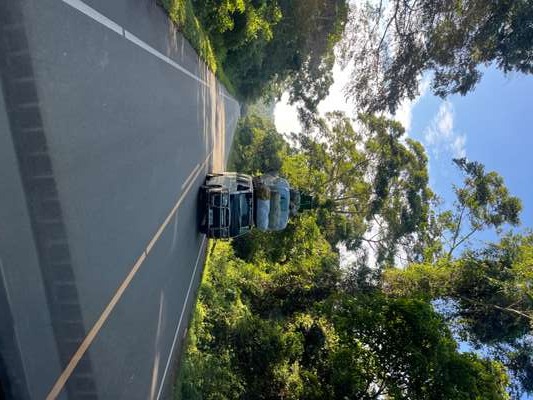
Driving north from Butiru toward Murchison Falls National Park in October 2024, the road was in surprisingly good condition — tarmac, wide shoulders, a long straight horizon through the savannah. Then, rounding a gentle bend, a vehicle appeared ahead that stopped the conversation in the car. A minibus, moving steadily in the same direction, was carrying a load on its roof that reached roughly twice the height of the vehicle itself: mattresses, rolled bedding, household goods, all roped together in a tower that should by any reasonable engineering assessment have toppled at the first pothole. It did not topple. The driver appeared entirely unbothered. Mark Suer photographed it from the passenger window, the GPS in his camera recording the coordinates that confirm the location. The image — now one of the most-viewed in his Uganda collection — captures something that visitors encounter repeatedly: a country where necessity and ingenuity combine in ways that appear improbable and yet clearly work.
That drive was part of a 12-day visit in October 2024, one of more than fourteen separate visits Mark Suer and Susanne Suer have made to Uganda, accumulating 65 days on the ground across multiple regions. The route to Murchison Falls passes through landscapes that speak directly to the subject of this article: the Victoria Nile flowing north from Lake Victoria, its banks fringed with papyrus and fever trees, the river carrying with it both the water and the fish that sustain communities across a vast arc of northern Uganda. Understanding how Uganda manages — and sometimes mismanages — this water and its fisheries is not an abstract policy question. It is the story of a resource that feeds tens of millions of people and that, in recent decades, has come under pressures that no earlier generation faced.
The Nile Perch Story: From Catastrophe to Crisis — Again
The introduction of Nile perch (Lates niloticus) into Lake Victoria in the late 1950s and early 1960s is one of the most studied ecological events in freshwater biology. Introduced deliberately to boost commercial fish production, the species proved devastatingly effective as a predator: within two to three decades it had driven hundreds of endemic cichlid species to extinction or near-extinction, fundamentally restructuring the entire food web of the world's largest tropical lake. The ecological damage was immense and irreversible. And yet, paradoxically, the same species that destroyed so much also created an export fishery that generated foreign exchange for Uganda, Kenya, and Tanzania, supported hundreds of thousands of livelihoods at landing sites around the lake, and put affordable animal protein on plates across the region.
This paradox — ecological catastrophe and economic lifeline in the same organism — defines the difficulty of Nile perch management to this day. Through the 1990s and early 2000s, the fishery grew rapidly: factories were built along the lake shore to fillet and freeze Nile perch for export to European and Asian markets, landing sites expanded, boat numbers increased. For a period, the combination of high catch volumes and strong export prices made Lake Victoria Nile perch one of sub-Saharan Africa's most valuable fisheries. Uganda's fish exports earned significant foreign exchange, and the fishing economy supported secondary industries in ice, nets, boat building, and transport.
The scale of this economy is considerable. According to Uganda's Industrialisation and Economic Development Strategy, Lake Victoria accounts for approximately 40% of Uganda's total fish catch, while an estimated 136,000 artisan fishermen operate on the lake and around 700,000 people in total benefit from fishery-related activities including processing, trading, and transport. The total catch, however, has been declining sharply: from 245,000 metric tons in 2014 to 140,000 metric tons in 2018 — a fall of nearly 43% in four years despite rising fishing effort. In Buikwe District alone, around 70,000 people depend directly on fishing in Lake Victoria and the Nile as their primary livelihood.
The problem that has accumulated since — and that the Uganda National Status of the Environment Report 2024 (NSOER 2024) addresses directly — is overexploitation. The signs are measurable and consistent. Total catch figures have not kept pace with the increase in fishing effort: more boats and more nets are required to land the same weight of fish. More critically, the size structure of Nile perch catches has shifted. Fish are being caught younger and smaller, before they have the opportunity to reproduce. A fishery that harvests primarily immature fish is, in effect, consuming its own future. The biomass of large, mature Nile perch — the animals that drive reproduction — has declined significantly from the peak levels of the 1990s and early 2000s. This is the pattern that fisheries scientists call overexploitation, and once established it is difficult to reverse without either drastically reducing fishing pressure or imposing and enforcing strict minimum-size regulations, both of which face intense resistance from communities dependent on the lake for daily income.
Destructive Practices and Their Consequences
The specific practices driving this decline are well documented, if unevenly regulated. Beach seining — dragging large nets through shallow water, including spawning and nursery areas — removes juvenile fish before they can grow to reproductive age. Fine-mesh nets intended for smaller species inadvertently catch Nile perch fingerlings as bycatch. And the sheer number of vessels operating on Lake Victoria has grown well beyond what the fishery can sustainably support at its current productivity level. Uganda, Kenya, and Tanzania have all adopted joint management frameworks through the Lake Victoria Fisheries Organisation (LVFO), setting minimum mesh sizes and closed seasons, but enforcement across a lake this size — nearly 69,000 square kilometres of open water and hundreds of kilometres of accessible shoreline — remains fragmentary.
[QUOTE: fisheries officer or landing site manager on enforcement challenges and changes in catch over the past decade — collect on next visit to lake shore]
The economic consequences of declining Nile perch stocks ripple far beyond the landing site. Export processing factories have reduced capacity. The price of Nile perch in local markets has risen as the supply of large fish decreases, pricing the protein out of reach for the poorest households. And the communities that built their livelihoods around this single species — fishing, processing, transport, selling — face a structural vulnerability that diversification of the catch base could partially address but has not yet adequately solved.
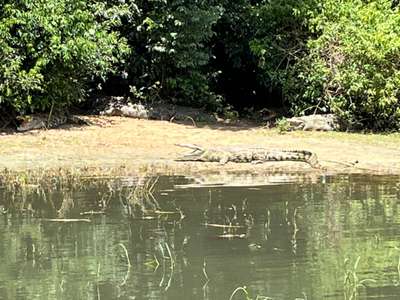
On the October 2024 boat safari along the Victoria Nile through Murchison Falls National Park, the river's ecological vitality was immediately apparent. Nile crocodiles — some of them large enough that their size remained impressive even at a distance from the boat — rested on sandbanks and slipped silently into the water as the vessel approached. Their presence here, as apex predators, is itself an ecological signal: a river system that can support large crocodile populations is one that still has the fish biomass to feed them. The Victoria Nile between Lake Albert and the falls is one of the reaches least affected by the pressures that have degraded the lake itself, and it shows. The crocodiles, the hippos, the birds working the shallows — all point to a system that, away from the urban and agricultural pressures of the lake shore, retains significant ecological function.
Water Quality in Uganda's Lakes and Rivers
Uganda's water resources are exceptional by any measure. The country holds portions of five of Africa's Great Lakes, is crossed by the upper Nile system, and contains an extensive network of rivers, wetlands, and seasonal swamps that together cover a remarkable proportion of the national territory. This abundance has historically supported both ecological diversity and human settlement at densities unusual for sub-Saharan Africa. It has also, increasingly, absorbed the waste products of a growing population and an expanding economy in ways that are now registering as measurable degradation across multiple monitoring parameters.
The Uganda NSOER 2024 documents water quality conditions across the country's major water bodies, and the picture it presents is one of significant spatial variation. Lakes and river reaches far from urban and agricultural centres — including stretches of the Victoria Nile through Murchison Falls National Park — retain good to excellent water quality. Closer to Kampala, the industrial and agricultural regions of central Uganda, and the major landing sites on Lake Victoria's northern shore, conditions deteriorate substantially. Murchison Bay, which receives drainage from Kampala through the Nakivubo channel and wetland, is among the most polluted sections of Lake Victoria; Nakiwogo and Kitubulu Bay, also on the northern shore, show elevated nutrient loads and reduced dissolved oxygen — conditions that directly stress fish populations and favour the growth of invasive water hyacinth.
The Interplay Between Urban Growth and Lake Health
The connection between Kampala's growth and Lake Victoria's declining water quality in its nearshore sections is not difficult to trace. Urban runoff carrying suspended solids, nutrients, and pathogens flows into the lake through the Nakivubo and Kajjansi channels. Industrial effluent — from food processing, tanning, and manufacturing — enters inadequately treated or untreated. Wetlands that historically buffered these inputs have been progressively filled for urban development, removing a critical filtration layer between the city and the lake. The result, documented repeatedly in environmental monitoring data, is eutrophication: nutrient enrichment that promotes algal blooms, reduces water clarity, and depletes the oxygen that fish require.
Water hyacinth (Eichhornia crassipes) flourishes in nutrient-enriched water. Its explosive growth in Murchison Bay and other nearshore areas of Lake Victoria is therefore partly a symptom of water quality degradation rather than simply a separate invasion problem. Removing the plants without reducing the nutrient load that feeds them is a Sisyphean task: mat clearance operations have been ongoing for decades, providing temporary relief at specific sites but unable to address the underlying nutrient flux. Lasting improvement in water hyacinth coverage in Murchison Bay will require lasting improvement in the quality of water draining into it from Kampala and its surroundings.
Lake Kyoga, Lake Albert, and Lake George each face their own specific pressures. George receives drainage from the Rwenzori foothills and is heavily influenced by hippopotamus populations whose waste contributes significantly to nutrient loading — a natural process, but one that interacts with agricultural runoff and effluent discharge in ways that have altered the lake's ecology over recent decades. Albert, bordered by both Uganda and the Democratic Republic of Congo, is affected by activities on both shores, making unilateral management measures inherently limited in their effectiveness.
Integrated Water Resources Management: Uganda's Framework Response
Uganda's formal response to these pressures operates through the framework of Integrated Water Resources Management (IWRM) — an approach that recognises the interconnectedness of water uses and users across a catchment, and seeks to coordinate them rather than managing each sector in isolation. In principle, IWRM means that decisions about agricultural water use, urban drainage, fisheries management, and industrial discharge are made with reference to each other and to the overarching capacity of the water system. In practice, implementing this coordination across the multiple ministries, local governments, and private actors involved in Uganda's water economy is an ongoing governance challenge.
The NSOER 2024 notes that monitoring programmes for Uganda's major water bodies are in place and generating data, which is the essential first step for evidence-based management. Understanding what is happening — where water quality is declining, which species are under pressure, which land uses are generating the most damaging runoff — is prerequisite to targeting intervention effectively. Uganda has invested in this monitoring capacity over the past two decades, and the resulting data underpins reports like the NSOER itself.
What the monitoring data increasingly points to is a set of pressures that are not diminishing on their own. Population growth, agricultural expansion, and urbanisation are all proceeding at rates that consistently generate more pollution and more fishing effort than the current management frameworks have been able to offset. This does not mean the situation is hopeless — there are well-documented cases of lake and river systems recovering when pressure is sufficiently reduced — but it does mean that incremental improvements in enforcement and monitoring are unlikely on their own to reverse trends that have accumulated over decades.
What Sustainable Management Requires
The elements of a functioning response to Uganda's water and fisheries pressures are understood, even if their implementation remains incomplete. For the Nile perch fishery specifically, sustainable management requires credible enforcement of minimum mesh sizes to allow juveniles to reach reproductive age, meaningful reductions in total fishing effort — which in practice means reducing the number of vessels operating on the lake — and investment in alternative livelihoods for fishing communities so that the economic pressure to fish beyond sustainable limits is partially relieved. None of these is straightforward in a context where fishing communities have few alternative income sources and where lake access is effectively open.
For water quality, the priorities are equally clear in principle: upgrading wastewater treatment for Kampala and other lakeside towns to reduce nutrient and pathogen loads reaching the lake; enforcing wetland protection regulations to preserve the natural filtration capacity of fringing wetlands; and supporting agricultural practices that reduce runoff of nutrients and pesticides into river systems. The KCCA's own strategic planning acknowledges the lake shore development challenge — the simultaneous imperative to develop Kampala's 19 kilometres of Lake Victoria waterfront while protecting the ecological systems that make that waterfront valuable.
Visitors travelling to Uganda encounter this tension in small, concrete ways. The extraordinary biodiversity visible on a boat safari through Murchison Falls — crocodiles, hippos, shoebill storks, Nile perch leaping in the current — coexists with a management context in which each of those species faces pressure from human activity further downstream or along the lake shore. The abundance is real; so is the fragility.
Water Access, Communities, and the Bigger Picture
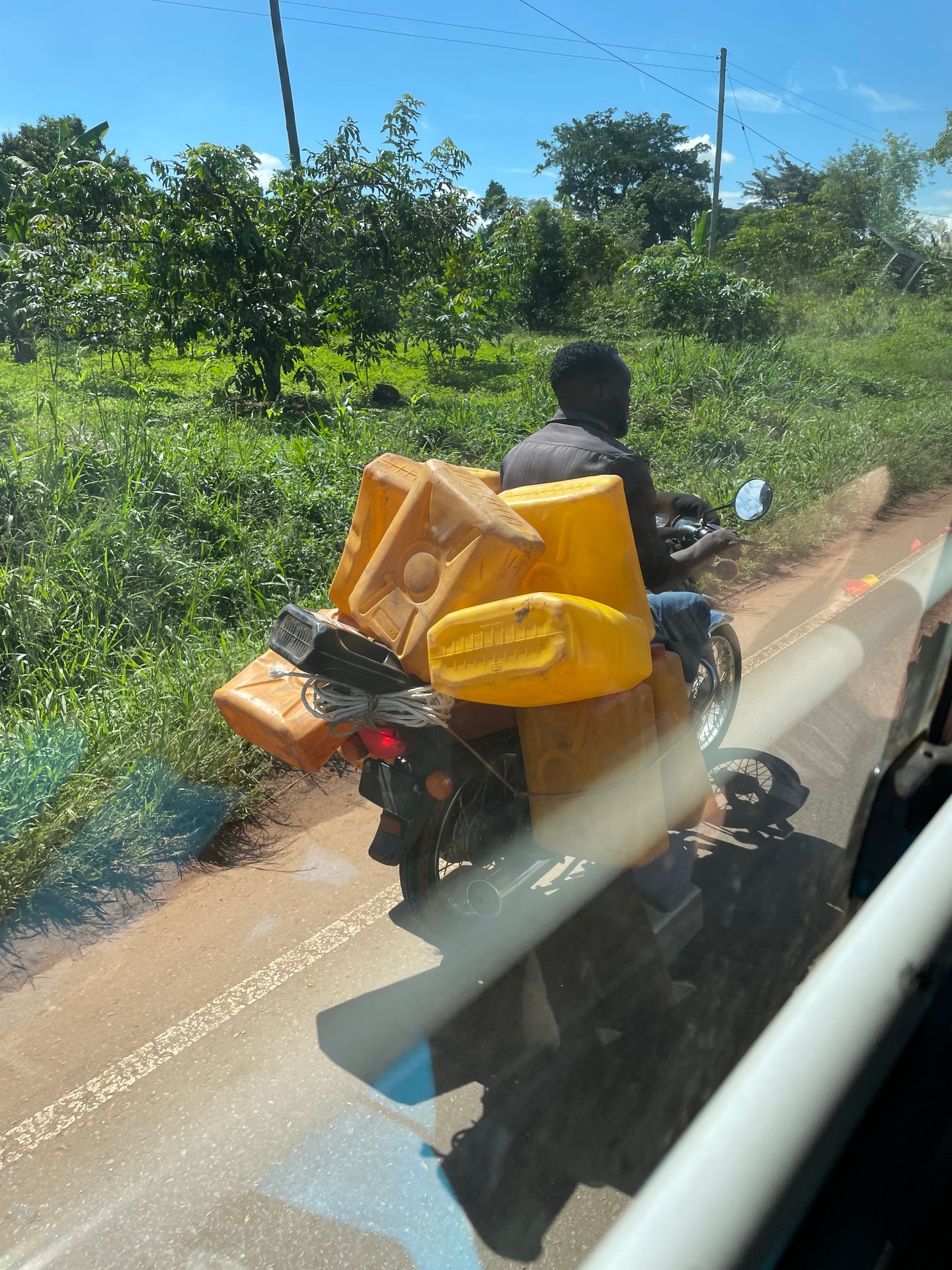
There is a gap between the large-scale narrative of lake management and the daily reality of water access that Ugandan communities navigate. On a rural road in October 2024, driving toward Murchison Falls, Mark Suer photographed a boda boda rider from the car window — a motorcycle loaded with an improbable number of large plastic water containers, the rider in sandals, no helmet, navigating the road with the practiced ease of someone who has made this run many times. It is the kind of image that stops a European traveller: not dangerous in any theatrical sense, but certainly outside the parameters of what European road regulation would tolerate. And it speaks directly to the gap between the water that Uganda has in abundance — visible from the air on approach to Entebbe, flowing past on the Victoria Nile, shimmering at the end of every kampala hillside that faces south — and the water that reaches individual households in rural areas.
Lake Victoria holds approximately 2,760 cubic kilometres of fresh water. Uganda sits at the lake's northern shore, with access that should in principle make water supply straightforward. The reality is more complicated: water treatment requires infrastructure; infrastructure requires investment; and the distribution of that investment across Uganda's 46 million people has not kept pace with population growth or the expansion of settlements into areas remote from treatment facilities. The boda boda rider carrying jerry cans is not a curiosity. He is part of an informal distribution system that fills a gap in formal water infrastructure — and that gap is directly relevant to the pressures on the lake, because communities without piped supply draw directly from surface water sources, including Lake Victoria itself, and because the same absence of infrastructure means that wastewater often returns to those sources untreated.
The IWRM framework recognises this link. Sustainable water management in Uganda is not only about fishing quotas and pollution monitoring: it is about ensuring that the investments in treatment, distribution, and sanitation keep pace with the population and economic growth that generate water demand and wastewater production. Uganda Vision 2040 and the Kampala Capital City Strategic Plan both identify these connections and set targets for improvement. The question — as with the Nile perch fishery — is whether the pace of progress will be sufficient to prevent further degradation before the trends become more difficult to reverse.