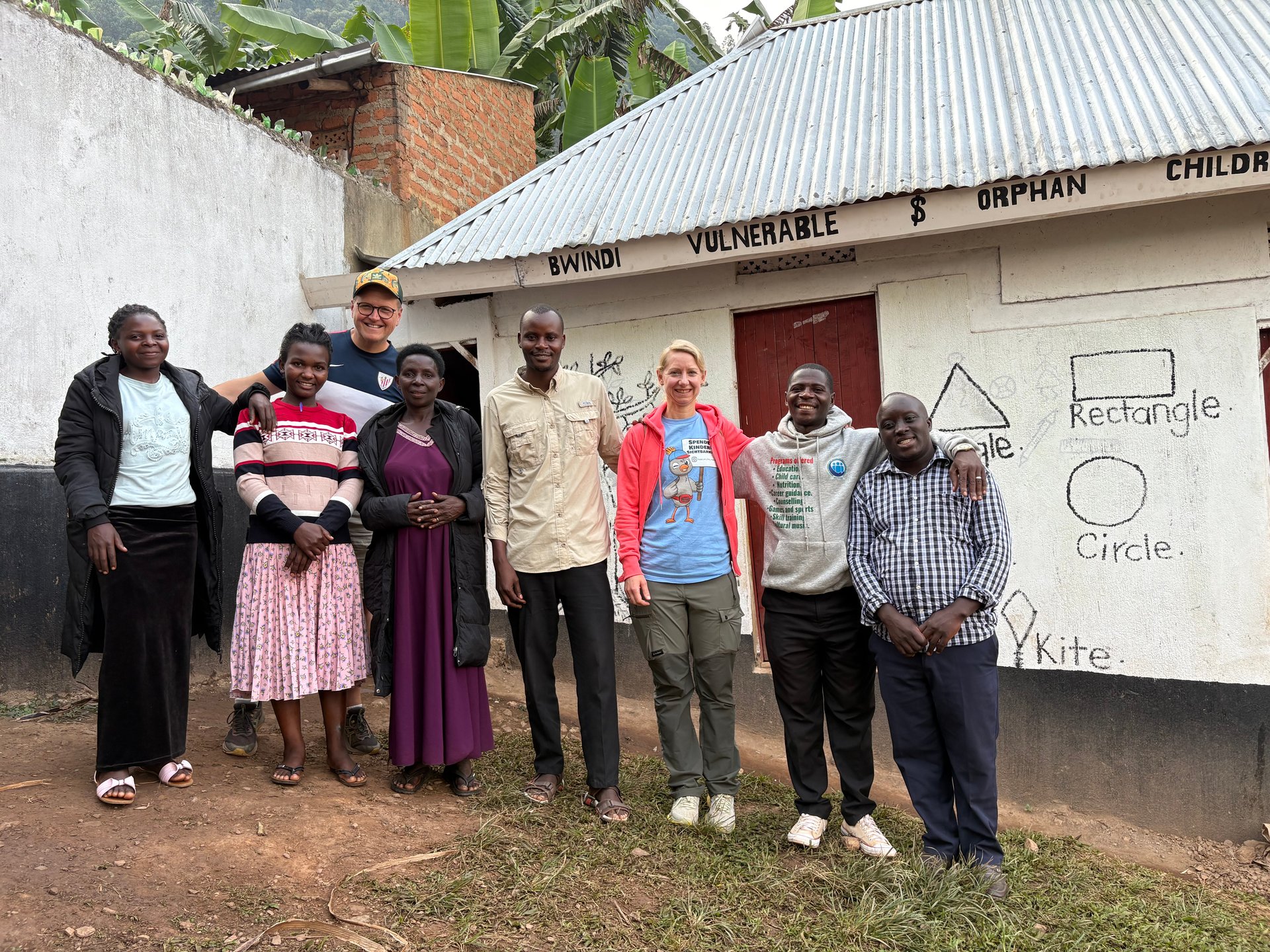
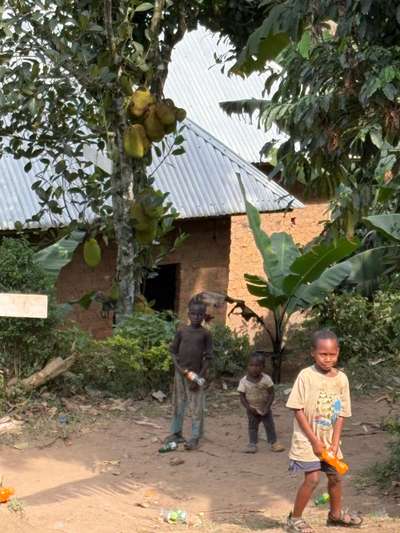
On the morning of 21 June 2026, three children appeared at the edge of the compound near the Buhoma orphanage. They were shy and kept their distance — their clothing was worn, their manner subdued in a way that went beyond reserve. It was clear at a glance that things were difficult for them. They were from the surrounding neighbourhood, not residents of the facility itself: children drawn to a place where meals happened, where adults paid attention. The decision to invite them to eat with us was immediate, without discussion. This moment — quiet, undocumented in any programme report, unlisted in any impact statistic — is also, in its own way, a fact about Uganda's tourism economy. These three children lived within walking distance of one of East Africa's most profitable wildlife tourism destinations. The gorilla trekking industry generates substantial income within a few kilometres of where they stood. The distance between that income and those children is the subject of this article.
Uganda's tourism sector is, by most measures, a genuine success story. The country holds mountain gorilla populations that cannot be seen anywhere else in the same density; it has chimpanzees, tree-climbing lions, the Nile, shoebill storks, Lake Victoria, Ssese Islands, crater lakes, and an extraordinary range of landscapes compressed into a country roughly the size of the United Kingdom. Across twelve days in October 2024, eleven days in January 2026, thirteen days in May 2026, and further visits in April and June 2026 — documented in GPS-tagged photographs taken across these periods — Mark Suer observed Uganda's tourism economy operating at ground level in multiple locations. The three GPS-verified photographs from 21 June 2026, taken within a four-minute window at -0.9617°N to -0.9735°N, 29.6108°E to 29.6281°E in the Buhoma area, are part of a much larger archive. What accumulates across that many days of direct observation is a picture more complicated than either the tourism industry's success story or its critics' simplest objections.
The question of who benefits from Uganda's tourism industry — and who does not — is not a rhetorical one. It has practical answers, which vary significantly by location, activity type, and how the visitor chooses to spend their money. This article examines those mechanisms honestly, drawing on direct observation from multiple visits and on the institutional structures that Uganda has built to channel tourism income into communities.
How Uganda's Park Revenue Is Distributed
Uganda Wildlife Authority (UWA) manages Uganda's national parks and wildlife reserves and collects the fees that visitors pay: park entry, permit fees for gorilla and chimpanzee trekking, boat safari fees, and various activity charges. These revenues are substantial. A single gorilla trekking permit generates USD 800 for a foreign non-resident visitor. Multiply by the eight permits per gorilla family per day, the multiple habituated families across Bwindi and Mgahinga, and the high occupancy of peak months, and the permit revenue from gorilla trekking alone runs to millions of dollars annually.
Uganda Wildlife Authority's revenue allocation model directs a portion of this income to a Community Revenue Sharing (CRS) fund. The CRS mechanism has been in place since the 1990s, established as part of the broader shift in conservation philosophy from exclusion models — in which parks were managed by keeping local people out — toward benefit-sharing models, in which local communities receive tangible economic returns from conservation. The theory is straightforward: if communities benefit materially from the existence of wildlife, they become stakeholders in its protection rather than competitors for the land and resources it occupies.
In practice, UWA allocates a defined percentage of park entry fees to parish-level development projects in communities surrounding each park. The allocations fund physical infrastructure — school buildings, health facility construction and equipping, water supply systems, community halls — rather than cash payments to individuals. Projects are identified through a process involving local government and community representatives, and construction is supervised by district authorities. The system has produced visible results: school buildings and health facilities in communities around Bwindi, Queen Elizabeth, Murchison Falls, and other parks are often partly or fully CRS-funded.
What the CRS System Does Not Reach
The community revenue sharing system is real and its effects are real. But its reach is also genuinely limited in ways that the children outside the Buhoma orphanage illustrate. CRS allocations go to formal community infrastructure — they fund buildings and systems, not individual households. The subsistence farmer on the hillside above Buhoma, the household without a child in the CRS-funded school, the family that arrived in the area after the latest CRS project cycle was set — none of these necessarily see direct material benefit. The orphanage itself, and the neighbourhood children around it, operate outside the formal project cycle that CRS funds.
The group most consistently left outside these formal benefit structures around Bwindi is the Batwa — Uganda's indigenous forest-dwelling people, who were displaced from the park when it was gazetted in 1991. The Batwa's historical relationship with the forest predates any conservation framework, yet they have no ancestral claim recognised within the CRS model and no formal land tenure in the surrounding parishes. Some NGO partnerships are beginning to address this gap: a 2025 assessment of Batwa communities in the Bwindi area documented an initiative called Empowering Vulnerable Communities (EVC), run in partnership with OVD (Italy), providing food security support, seeds, seasonal agricultural tools, and health and education engagement. These are meaningful interventions, but they operate outside the formal tourism revenue-sharing system and depend on NGO funding cycles rather than the sustainable income stream that gorilla permit revenues represent.
Moreover, CRS allocations are distributed among all communities in the surrounding area, not concentrated at the village gates. A community ten kilometres from the park boundary receives the same CRS access as one adjacent to the park fence. The economic logic of this design is defensible — it avoids incentivising settlement immediately adjacent to the park, which would increase human-wildlife conflict — but it means that the households most affected by the park's existence (those losing access to forest resources they previously used) are not necessarily the households receiving the largest share of CRS funding.
Uganda Community Tourism Association: Lake Victoria and Beyond
Outside the national park system, Uganda Community Tourism Association (UCOTA) provides the organisational framework for community-based tourism operations across the country. UCOTA is a membership organisation of community groups and individual operators that aggregates marketing, training, and standards-setting functions that individual community tourism enterprises could not efficiently provide independently. Its membership includes community lodges, craft cooperatives, cultural experience programmes, and guide services in areas ranging from Lake Victoria's shoreline communities to the crater lake zones of western Uganda.
The Lake Victoria dimension of UCOTA's work is particularly relevant to this portal. Lake Victoria's Ugandan shoreline — 200-plus kilometres of it — includes numerous fishing communities, landing sites, and island settlements whose residents have a direct economic relationship with the lake but have historically had limited access to the tourism income generated by Entebbe-based operators taking visitors to Ngamba Island, the Ssese Islands, or Mabamba Swamp. UCOTA-affiliated operators in these communities offer an alternative channel: visitors who book fishing community tours, shoreline homestays, or locally guided boat trips through UCOTA-networked operators are spending money that stays predominantly in the lakeside community rather than in a Kampala or Entebbe head office.
[QUOTE: local UCOTA guide or community tourism operator on Lake Victoria — collect on next visit]
Community Lodges and Their Economic Model
Community lodges — accommodation properties owned and operated by community groups rather than private investors — represent the most direct form of community benefit from tourism. When a visitor sleeps at a community lodge, the accommodation revenue goes into a community-managed fund rather than a private account. Staff are local. Food purchases, where possible, are from local producers. The multiplier effect of this spending pattern within a small community is substantially higher than the same amount spent at a privately owned lodge that employs local staff but remits profits to urban owners.
Community lodges vary enormously in quality and management effectiveness. Some are well-run, well-maintained, and offer a genuine accommodation experience that competes with private-sector alternatives on character if not always on comfort. Others suffer from the management challenges that affect any community enterprise: collective decision-making on maintenance spending, staff accountability without individual ownership incentives, and the difficulty of reinvesting in property improvements when the community has competing claims on any surplus. Selecting a community lodge requires some advance research; UCOTA membership and recommendations from other travellers are the most reliable indicators of operational quality.
The Fishing Communities of Lake Victoria
Lake Victoria's fishing communities represent a distinct category of community tourism opportunity that is less well-developed than the national park CRS system but potentially more directly transformative for the communities involved. The lake's shoreline communities have historically been economically marginalised relative to Kampala and Entebbe: fish prices are set by traders with market power; infrastructure investment has lagged behind lakeside towns; the pollution and water hyacinth problems that affect the lake's ecology directly affect community livelihoods without the communities having meaningful voice in the policy decisions that determine how those problems are addressed.
Tourism offers these communities an alternative or supplementary income stream that bypasses the trader-dominated fish value chain. A visitor who pays a local guide to spend a morning at a fishing landing site — watching the overnight catch come in, learning about the tilapia and Nile perch and mukene that define the lake's commercial fishery, having breakfast prepared by a community member from the morning's catch — generates income for the guide, the cook, and potentially the boat operator, all within the community. This is not a transformation of the community's economic position; it is a marginal diversification that adds resilience. But marginal diversification, done consistently and at scale, is what community economic development actually looks like.
The water hyacinth that blocks boat access to some Lake Victoria landing sites is not merely an ecological problem. It is an economic barrier that affects both fishing productivity and tourism access simultaneously. Clearing hyacinth from a landing site opens both livelihood streams. The Uganda Wetlands Management Programme has oversight responsibility for wetland and aquatic ecosystem management, and the National Fisheries Resources Research Institute (NAFIRRI) conducts the research that informs stock assessments and management decisions for the lake's fisheries. These institutional actors shape the conditions in which fishing community tourism can or cannot function — which means that conservation and tourism development on Lake Victoria are inseparable in practice, even when discussed as separate policy domains.
How Visitors Can Direct Spending to Communities
The question of how individual visitors can maximise the community benefit of their Uganda trip has a practical answer, though it requires active choices rather than the default tourist behaviour of booking an all-inclusive package and leaving the distribution question to the operator. The following are the mechanisms that actually work, observed across multiple visits and consistent with how the tourism economy operates on the ground.
Hire Local Guides Directly
The guide is the primary employment interface between tourism and community. A guide hired through a Kampala-based company generates income for that company and a wage for the guide; a guide hired directly from the local area generates the full day-rate within the community. In areas with established community guide associations — Bwindi, the Ssese Islands, Mabamba Swamp for shoebill birding — direct hire is possible and generates substantially more local economic benefit per visitor spending unit than operator-mediated hire. This is not always convenient, particularly for first-time visitors who benefit from the logistics management that an operator provides. But on a return visit, or for visitors with time to make local arrangements, direct hire is one of the clearest available mechanisms.
Eat and Sleep Locally
The choice between a lodge that sources food locally and employs community members versus one that imports supplies and employs mostly urban staff has measurable effects on local income. This information is not always easy to obtain in advance — lodge marketing materials do not typically quantify their local procurement percentages. But asking directly, choosing guesthouses in village centres rather than lodges on the periphery, and eating at locally owned restaurants rather than lodge restaurants are behaviours that consistently direct more spending into communities. In Buhoma specifically, several locally owned guesthouses and eating places operate within the village — accessible to visitors staying at either end of the accommodation price range.
Buy Crafts from Producers, Not Middlemen
Craft sales at tourist sites — the curio market outside a park gate, the craft stall at a ferry terminal — involve multiple layers of intermediaries between the producer and the buyer. The same item bought directly from a weaving cooperative, a pottery workshop, or an individual craftsperson in a village puts a substantially higher proportion of the purchase price into the producer's hands. This requires more effort — finding the cooperative, making the visit, managing the transaction in a context where price negotiation is expected — but the income transfer per unit of visitor spending is meaningfully higher. UCOTA-affiliated craft cooperatives on Lake Victoria and around the national parks are a starting point for locating direct-purchase options.
The Governance Question: Fees, Permits and Ministerial Oversight
The mechanism by which park fees and water use charges are set and administered matters directly to community benefit. In Uganda, significant fee adjustments — including the water fees charged to utilities that draw from Lake Victoria and the permit prices charged to tourists — require ministerial approval, giving the relevant minister substantial discretionary power over the revenue flows that underpin both conservation and community benefit programmes. This is not unusual in African governance structures; it means that the income available for community revenue sharing is determined as much by political decisions about fee levels as by the visitor numbers that generate the underlying revenue.
Gorilla trekking permit prices, for instance, have been set and revised by administrative decision rather than by market mechanism — the current USD 800 price for foreign non-residents reflects a deliberate positioning of Uganda's gorilla product as premium rather than mass-market, a decision with implications for both the total revenue generated and the profile of visitor that the country attracts. A lower permit price would bring more visitors but less revenue per visit; whether more visitors or more revenue per visitor better serves community benefit is a genuinely contested policy question with no obvious right answer.
Water fees on Lake Victoria — charged to utilities and potentially to commercial fishing operations — similarly involve regulatory decisions at ministerial level, with consequences for the incentive structures that govern how the lake's water resources are managed. These are technical, unglamorous governance questions that rarely appear in travel articles about Uganda. But they determine the conditions in which community tourism either succeeds or fails, and they are part of what a complete picture of Uganda's tourism economy requires.
The Lake Victoria Dimension
Lake Victoria sits at the centre of Uganda's tourism geography without always being at the centre of its community tourism development. The lake is the entry point — most international visitors arrive and depart via Entebbe on the lake's northern shore — but the premium tourism products that generate the largest community revenues are inland: gorilla trekking at Bwindi, chimpanzee tracking at Kibale, game drives and boat safaris at Queen Elizabeth and Murchison Falls. The lake itself, despite its size and its ecological and cultural significance, generates relatively modest community tourism income compared to these national park products.
This reflects partly the stage of tourism development around the lake — Ssese Islands tourism is growing but remains small relative to the national park circuit; shoreline community tourism is nascent; the lake's urban waterfront in Kampala and Entebbe has not been developed into a tourism amenity in the way that city waterfronts in other parts of the world have — and partly the structural challenges of the lake itself: water hyacinth, water quality issues in the bays close to Kampala, and the absence of the concentrated wildlife that makes national park boat safaris a reliable visitor experience.
The twenty docking piers planned for Uganda's water bodies, as documented in Uganda Tourism Board planning materials, represent an attempt to change this. Better pier infrastructure on Lake Victoria's shoreline would lower the access barrier for community tourism operations — a community guide service cannot function efficiently if the boat has to push through hyacinth mats to reach the landing site. Whether the planned infrastructure translates into improved community tourism outcomes depends on whether it is accompanied by the training, market access, and organisational support that community operators need, not just physical infrastructure.
The children outside the Buhoma orphanage in June 2026 are not a policy argument or a fundraising image. They are three specific children in a specific place, living in proximity to a tourism economy that does not automatically include them. The mechanisms that connect that economy to their circumstances are real, operational, and in some respects working. They are also incomplete, uneven, and dependent on governance decisions that are made largely without their input. Acknowledging this honestly — rather than presenting Uganda's community tourism as either a success story or a failure — is the most useful thing a travel guide can do.