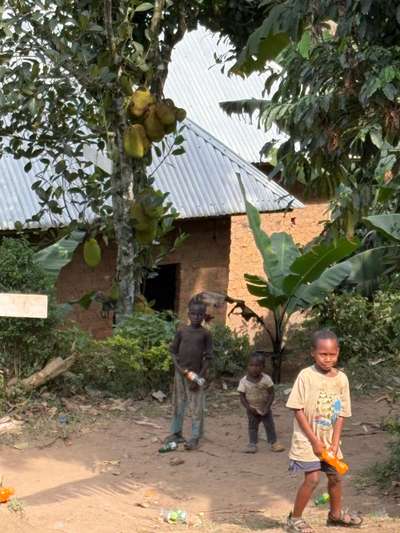
Early one morning in June 2026, in the village of Buhoma in southwestern Uganda, three children from the neighbourhood of the local orphanage appeared at our door. They were timid — their clothes worn, their manner careful in the way of children who have learned not to expect much from sudden encounters. We invited them in to eat without discussion. That photograph, GPS-tagged at coordinates -0.9617, 29.6109 and taken by Mark Suer at 06:32 on 21 June 2026, does not show Lake Victoria in East Africa directly. But it shows the texture of the region that the lake sustains — the village level, the daily economy, the quiet human reality that sits below the layer of tourism marketing.
Lake Victoria East Africa is a subject most people approach from the outside: a number on a map (68,800 square kilometres), a superlative (Africa's largest lake), a destination (the Ssese Islands, the source of the Nile). What those framings miss is the functional geography of the lake — the dozens of landing sites where fishing boats pull in before dawn, the ferry piers that connect island communities to mainland markets, the hotels and lodges built to bring visitors to the water, and the serious gaps in maritime safety infrastructure that make the lake considerably more dangerous than its visual calm suggests. Across eleven days in October 2024, and on further visits in January and May 2026, I travelled Uganda's Lake Victoria shoreline repeatedly. This is what the working lake looks like.
The Landing Sites — Where Lake Victoria East Africa Actually Functions
The tourist experience of Lake Victoria begins at a pier — Entebbe, Nakiwogo, a hotel jetty. The working experience of Lake Victoria begins at a landing site, and Uganda has dozens of them distributed along the northern and western shoreline. These are the economic joints of the lake: where fish come off the water, where supplies go on, where ferry passengers wait in the early morning half-light for the boat to the islands.
A comprehensive transport strategy document for Uganda's Lake Victoria region identifies the following as key landing sites for fishing activities on the Ugandan shore:
| Landing Site | District | Primary Function |
|---|---|---|
| Kasenyi | Wakiso | Fishing; Ssese ferry connections |
| Kigungu | Wakiso | Fishing; vehicle ferry to Ssese |
| Katosi | Mukono | Fishing |
| Ssenyi | Mukono | Fishing |
| Masese | Jinja | Fishing; cargo |
| Wairaka | Jinja | Fishing |
| Gaba | Kampala | Fishing; boat charters |
Kasenyi sits eight kilometres east of Entebbe on a peninsula below the Kampala road, and it is one of the most accessible working landing sites for visitors. The activity begins before first light. On a visit during October 2024, the pier at Kasenyi was alive from around 5 a.m.: wooden boats returning from overnight fishing, traders weighing tilapia and Nile perch on hand scales, women carrying baskets of smoked mukene (the small dried sardines that are a staple protein source across Uganda). By eight in the morning, the boats were cleaned and the fish had largely dispersed into the Kampala supply chain. Tourism piers and working landing sites occupy parallel realities at Lake Victoria East Africa — physically close but temporally offset.
Kigungu, also in Wakiso District, serves a different function: it is the primary departure point for the vehicle ferry to the Ssese Islands. Passengers travelling without cars more commonly use the MV Kalangala service from Nakiwogo pier near Entebbe, but Kigungu handles the movement of goods and vehicles that keeps island communities supplied. The crossing to Bugala Island takes several hours, and the ferry schedule is not always reliable — an issue that the regional transport strategy notes as a constraint on the Ssese Islands' economic integration with the mainland.
[QUOTE: ferry operator at Kigungu on how the crossing has changed since the MV Kalangala launched]Gaba — Kampala's Direct Connection to the Lake
Gaba is the one landing site that sits within Kampala city limits, at the southern edge of the Kampala metropolitan area where the Ggaba road ends at the lake. It is less a fishing village than a semi-urban waterfront — boat hire companies, a handful of restaurants, and the departure point for private charters to Ngamba Island Chimpanzee Sanctuary and to the Ssese Islands. According to Uganda's Statistical Abstract 2019, Kampala directly borders Lake Victoria and is surrounded to the west and north by Wakiso District — Gaba is the most tangible expression of that geographic fact for most Kampala residents.
Maritime Safety on Lake Victoria — The Gap Nobody Discusses
Lake Victoria East Africa has a documented and serious maritime safety problem that receives almost no attention in travel content. A regional transport and connectivity strategy report covering Lake Victoria's infrastructure concludes that lake navigability and maritime safety are not yet sufficiently addressed. The report notes specifically that while all registered vessels on the lake are equipped with radio communication systems, none of the lake ports issues formal weather warnings, storm advisories, or navigational notices to departing ships. Vessels leave Ugandan, Kenyan and Tanzanian ports with no systematic information about conditions ahead.
No weather forecasts or storm warnings are issued at any Lake Victoria port. Afternoon storms develop rapidly and without warning. Always depart before noon, use licensed operators with certified life jackets, and confirm conditions with local boat operators before boarding. This applies to tourist trips as well as commercial crossings.
The consequences of this gap are not theoretical. Lake Victoria has a long history of fatal accidents, most involving overcrowded or poorly maintained vessels caught by the rapid afternoon storms for which the lake is known at altitude. The asymmetry between the lake's apparently calm morning surface and its afternoon storm potential is something that every experienced local operator understands but that visitors are rarely warned about in formal terms.
The Lake Victoria Basin Commission (LVBC), in partnership with the East African Community partner states, has been planning a Maritime Rescue Coordination Centre to be established in Mwanza North, Tanzania. The facility is intended to be funded by the African Development Bank, and plots for the centre had already been acquired at the time the regional transport strategy was compiled. Whether this coordination centre is now operational [RECHERCHE NOETIG — verify current status] would represent a meaningful improvement in safety management for the lake as a whole.
For travellers, the practical implication is simple: take morning departures, ask operators directly about their safety certification, and never board a vessel that does not carry adequate life jackets for all passengers. The beauty of Lake Victoria East Africa is entirely real — the scale of the water, the pelicans riding thermals above the channel, the smell of fresh fish at a working landing — but it is a working natural environment with genuine hazards that deserve respect.
Hotels and Lodges on Lake Victoria in East Africa
The accommodation offer around Lake Victoria East Africa ranges from working-town guesthouses near fishing landing sites to some of Uganda's most luxurious properties. The lake's proximity to Kampala means that the highest-end options are within reach of the capital as a weekend or overnight destination — a market quite different from the island or remote-shore stays that attract longer-stay visitors.
Lake Victoria Serena Hotel — Lweza-Kigo Road
The Lake Victoria Serena Hotel occupies a large property on the Lweza-Kigo Road off the Entebbe Highway, approximately halfway between Kampala and Entebbe. The hotel is part of the Serena Hotels group, a Kenyan chain with flagship properties across East Africa. Double rooms start from around $170 per night. The property is notable for its scale and setting: cascading pools and fountains lead guests from the main building down toward the lake's edge, and the adjacent eighteen-hole golf course with its own clubhouse restaurant makes the hotel as much a leisure complex as a place to sleep. The Serena brand runs a five-star city property on Nakasero Hill in Kampala as well, with 152 rooms and suites — the lake property is a different kind of experience, oriented toward the water rather than the city.
Lake Victoria Hotel — Entebbe
The Lake Victoria Hotel in Entebbe is one of the town's landmark properties, situated directly on the lake with a large swimming pool that sits between the hotel building and the shore. It is a well-established option for visitors arriving at Entebbe International Airport who want to extend their stay by the water before or after a safari itinerary. Its position makes it convenient for day trips to Ngamba Island Chimpanzee Sanctuary, and the hotel's pier provides direct water access.
Victoria Forest Resort — Kalangala, Ssese Islands
For visitors who want to experience Lake Victoria East Africa from the islands rather than the mainland, the Victoria Forest Resort on Kalangala (Bugala Island) is the primary resort option in the Ssese archipelago. It offers a swimming pool, a beach section, bicycle hire, and a range of water-based activities directly from the island shore. The resort's location in the middle of the lake means that the full scale of Lake Victoria becomes apparent from its terrace — the water extends in every direction to the horizon, and the sound of the lake replaces the background noise of the mainland entirely.
The Pearl of Africa Hotel — Kampala
The Pearl of Africa Hotel, which opened in 2017 on Nakasero Hill in Kampala, is not directly on Lake Victoria but belongs to the category of high-end accommodation that positions the lake as part of Uganda's broader tourism identity. The hotel's three terraced pools cascading down the hillside are designed partly as a visual echo of Uganda's water landscape. For visitors combining Kampala time with lake excursions, it represents the most prominent new luxury option in the capital.
Lake Kyoga, the Upper Victoria Nile and the River System of East Africa
Lake Victoria does not exist in hydrological isolation. It is the upstream reservoir for a system of lakes and rivers that extends northward across Uganda before eventually reaching the Sudan border and beyond. Understanding this river system helps explain both the ecological significance of Lake Victoria East Africa and the environmental vulnerabilities that affect communities far from the lakeshore itself.
The Victoria Nile and the Bujagali Dam
Water exits Lake Victoria at Jinja on Uganda's northern shore, where the White Nile begins. From the Owen Falls Dam (now submerged under the Nalubaale hydropower facility) and the Kiira Dam just downstream, the river flows over what were once the Bujagali Falls — one of Uganda's most dramatic natural features and formerly the start of a major whitewater rafting industry. The construction of the Bujagali Dam, completed in 2012, submerged the falls and transformed the Upper Victoria Nile section between Jinja and the new reservoir. The rafting industry has adapted: several of the most spectacular rapids now lie under the dam's reservoir, and operators have restructured their routes accordingly, offering half-day trips on the sections that remain above water and developing alternative activities including stand-up paddleboarding and kayaking on the calmer stretches.
The Upper Victoria Nile is important not only for hydropower and tourism but for fisheries. Nile perch, which are the primary export fish species from Lake Victoria East Africa, are also found in the Upper Victoria Nile section, though dam construction has altered their movement patterns and reduced population sizes in some stretches. The LVFO coordinates fisheries management for the lake itself, but the river sections above and below the dams fall under different national regulatory frameworks.
Lake Kyoga — Uganda's Intermediate Lake
Lake Kyoga sits in central Uganda, connected to Lake Victoria via the Victoria Nile. It is a shallow, papyrus-fringed lake that functions as an enormous wetland system rather than a deep open-water body. Kyoga's Ramsar-listed wetlands support significant biodiversity — waterfowl, hippos, crocodiles, and a number of fish species — and provide livelihood support for lakeside communities in the Kyoga Basin. Because Lake Kyoga receives outflow from Lake Victoria and drains northward into the Albert Nile, changes in Victoria's water level directly affect Kyoga. The lakes are climatically and hydrologically coupled, and long-term changes to rainfall patterns in the Lake Victoria catchment register downstream at Kyoga within months.
The Akagera River — Feeding Victoria from the East
Lake Victoria receives water not only from Uganda's rainfall but from the east, via the Akagera River system. The Akagera (also called the Kagera) rises in the highlands of Rwanda and Burundi, flows northward through Rwanda, forms the border between Rwanda and Tanzania in its lower course, and eventually flows into Lake Victoria on the eastern shore. The Akagera River passes through the Akagera National Park in Rwanda — a protected area managed in partnership with African Parks Network — before crossing into Tanzania. The river is one of Lake Victoria's most significant inflows, and its condition reflects the health of the broader East African highland catchment. Deforestation, agricultural runoff, and sediment loads from the Rwandan and Burundian highlands all eventually reach Lake Victoria via this route.
Kampala and Lake Victoria — The City at the Water's Edge
According to Uganda's Statistical Abstract 2019, Kampala directly borders Lake Victoria and is surrounded to the west and north by Wakiso District. This geographic fact shapes more of the city's daily life than is immediately visible. Kampala's drainage flows toward the lake. The fish that supplies the city's markets comes from it. The humidity that characterises the capital's climate is partly generated by it. And the development pressures along the southern urban fringe — new roads, port infrastructure, real estate on the lakeshore — are all negotiations with the lake's edge.
The Kampala Capital City Authority's Strategic Plan for 2025–2030 references the EAC Vision 2050, which sets five strategic pillars for regional development: infrastructure through the Northern Corridor, industrialisation, resource and environmental management, tourism and trade, and human capital development. Lake Victoria East Africa sits squarely within at least three of these pillars, and Kampala's relationship with the lake — as a port city, as a tourism gateway, and as a source of environmental pressure — is central to how the EAC Vision is likely to play out in Uganda's case.
For travellers spending time in Kampala before or after a lake visit, the city offers a number of cultural entry points. The African Crafts Village adjacent to the National Theatre on Nakasero Hill sells traditional Ugandan crafts, textiles and sculpture in a village-style market setting. The 32°-EAST Ugandan Arts Trust in Kampala provides studio spaces for young Ugandan artists and hosts exhibitions and events that reflect the contemporary cultural life of a city in rapid transition. These are not lake destinations, but they are part of the East African urban fabric through which most Lake Victoria visitors pass — and which the lake's economy, in part, underwrites.